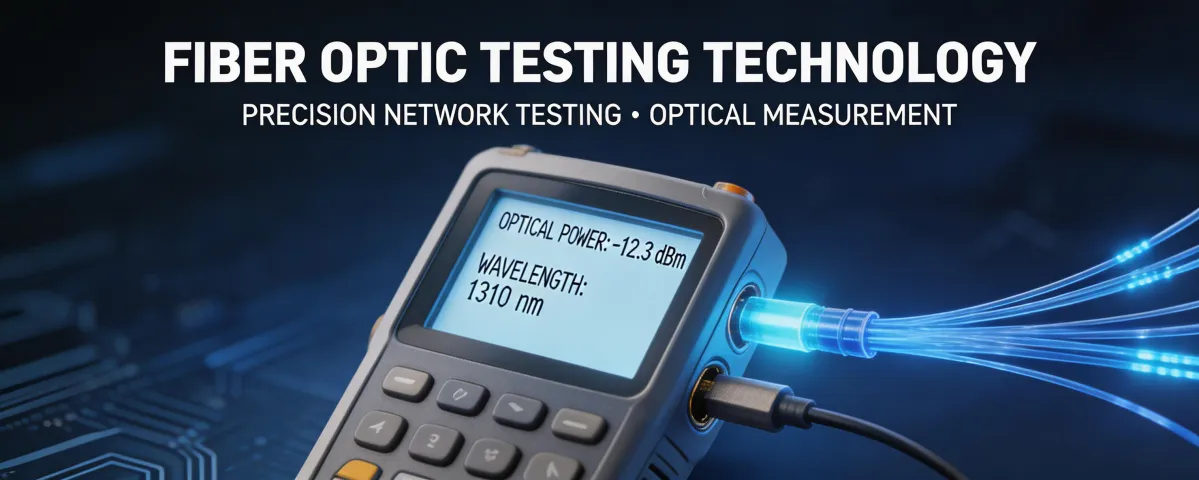
If you ask five field managers what 'field device' means, you'll get five different answers. Some will say test equipment. Some will say phones. Some will say a health monitor. All of them can be right, which is exactly why buying these tools is so frustrating. I'm the office administrator for a 60-person field services company. I process 60-80 equipment orders a year, manage about $150,000 in purchases across 8 vendors, and report to both operations and finance. This post is my practical way of thinking about field device purchases, not a spec-by-spec review.
There isn't one right field device setup
What was best practice in 2020 may not apply in 2025. The fundamentals haven't changed—match the tool to the job—but the execution has transformed. For basic fiber loss checks, an EXFO FLS-300 light source is still a solid workhorse. For multi-technology network teams, the modular EXFO FTB-500 might be the better fit. And if your crew works in rain, mud, and bucket trucks, the DuraXV Extreme might be more important than the test set with the biggest feature list.
No single product can cover all of these well. If someone tells you otherwise, they're trying to sell you something.
Here are the four scenarios I use when ordering equipment. Find yours, then read that section.
Scenario 1: You just need to verify fiber loss, not run a full lab
If your techs handle FTTH/PON jobs, short metro spans, or splicing verification, they probably don't need a high-end OTDR every day. They need to know whether a splice or connector has too much loss. That's where the EXFO FLS-300 fits. According to EXFO's product documentation (source: EXFO.com, January 2025), the FLS-300 is a stabilized light source available in single-mode and multimode versions. Paired with a power meter, it gives you a clear pass/fail reading without the learning curve of trace analysis.
When I took over purchasing in 2021, I almost ordered a fleet of full OTDRs because the sales demo looked great. The numbers said go with the bigger devices; my gut said wait. I was one click away from spending over $40,000 on capability we'd use maybe 10 percent of the time. Instead, we bought two EXFO FLS-300 bundles (I want to say around $2,100 each, but don't quote me on that—that was a bundle price in 2024) and a good power meter. Our techs learned them in an afternoon. The FLS-300 is still in the field every day.
To be fair, an OTDR is necessary when you need to locate a break, not just confirm loss. If that's your daily reality, skip this scenario. But for basic verification, the simplified advice 'always invest in the biggest test set' ignores the cost of unused functionality, extra training, and larger repair bills.
Scenario 2: You're building out multi-technology networks and need modular flexibility
If your team's test list changes week to week—access, metro, maybe lab work—you probably don't want a separate box for every test. This is the scenario where the EXFO FTB-500 makes sense. It's a modular platform, so you can swap in an OTDR module, an optical switch, or other test modules depending on the job. The key is to choose the modules first, then buy the platform, not the other way around.
In our 2024 vendor consolidation project, we looked at the FTB-500 for the two senior techs who do the complex jobs. I asked them to list the actual tests they ran in the previous six months. That list drove the module order. It was tempting to buy a fully loaded platform with every option. But the quote doubled, and most of those modules would have sat in the case. We went with a smaller set of modules, and it's worked out.
Every spreadsheet I ran pointed to a cheaper platform from a different vendor. Something felt off about the vendor's module lead time, so I trusted my gut and stayed with EXFO. A few months later, that other vendor announced shipping delays. Dodged a bullet.
To be fair, the FTB-500 is a serious investment. It only makes sense if the modules you need actually exist and you'll use them more than once a quarter. If you only need one test function, the FLS-300 route is smarter.
Scenario 3: Your techs need a rugged field communication device
This is separate from test equipment, but it's still a field device. For us, the most important communication device isn't a smartphone. It's the Sonim DuraXV Extreme. That's a rugged flip phone rated IP68 and MIL-STD-810H (source: Sonim.com, January 2025). It has long battery life, programmable buttons, and it's built to survive being dropped on concrete. It does not have a big touchscreen, and that's exactly why it works for field crews.
When we issued DuraXV Extreme devices, I expected pushback because they look 'old school.' Instead, the techs loved them. The number of cracked-glass repairs dropped to zero. I can't pull the exact repair cost from memory—it was around $4,400 per year before, maybe $4,500, I'd have to check—but the savings covered the device cost in the first quarter.
I get why some managers buy rugged smartphones instead: apps for maps, tickets, and photos. If your crew needs that, a rugged smartphone might be the right choice. But if you need a device for calls, push-to-talk, and texts that survives the field, don't overlook the DuraXV Extreme. The mainstream advice 'give everyone a smartphone' isn't automatically wrong, but it's not automatically right either.
Scenario 4: You're responsible for the humans, not just the tools
This one feels off-topic until it isn't. In 2022, one of our techs started having headaches and chest tightness on site. He was in his 50s and physically fit. The doctor found high blood pressure. We realized we had no idea how field staff were doing between annual checkups, so we added blood pressure monitors to our health and safety program.
If someone asks me what the best blood pressure monitor for field teams is, my answer is a validated upper-arm monitor with memory and a cuff that fits a range of arm sizes, not a wrist model. The American Medical Association recommends validated upper-arm monitors for most adults (source: American Medical Association, 2022). We keep one in each district truck and office. Technicians take a reading after a stressful event or when someone feels off, then text the result to their supervisor. It's not a medical diagnosis, but it's an early warning signal.
You don't need Bluetooth sync or an app that forces another account. You need reliability and simplicity. That's why the best blood pressure monitor for our field crew looks a lot less 'smart' than the wellness devices sold in consumer stores.
How to tell which scenario you're in
Here's the decision guide I use before ordering anything. It's not elegant, but it works:
- If your daily test is one fiber type and you only need pass/fail loss readings, start with an EXFO FLS-300 and a calibrated power meter.
- If your tests change week to week and span different network technologies, build a module list and see whether the EXFO FTB-500 has those modules. If it does, buy the platform around the modules.
- If your techs crack screens or run out of battery by lunch, evaluate the DuraXV Extreme.
- If your field staff work alone or in high-stress conditions, buy a validated upper-arm blood pressure monitor before you need it.
Don't start with 'Which product is best?' Start with 'Which failure am I trying to avoid?' That changes everything. The cheapest option is only cheap if it prevents the failure you're actually facing. What was best practice in 2020 may not apply in 2025. The fundamentals haven't changed, but the execution has transformed.
Final thought
There's no universal answer. A four-person rural fiber crew doesn't need the same fleet as a 200-person metropolitan network team. The industry is evolving, so the goal isn't a perfect device list; it's keeping your devices aligned with the work. Right now, our order list looks like this: basic EXFO FLS-300 units for daily fiber checks, one EXFO FTB-500 for complex jobs, DuraXV Extreme for field communication, and a blood pressure monitor in every vehicle.
If you're an admin buyer like me, vendors will want to sell you the biggest, most complete package. My advice: verify the scenario first. Ask techs what they actually do. Check which modules exist before you buy a platform. And don't let the word 'device' make you think only about electronics. Sometimes the best field device in the fleet is the one that keeps your team healthy enough to use all the others.
Pricing and specs as of January 2025; verify current rates with EXFO, Sonim, and your preferred health device distributor.