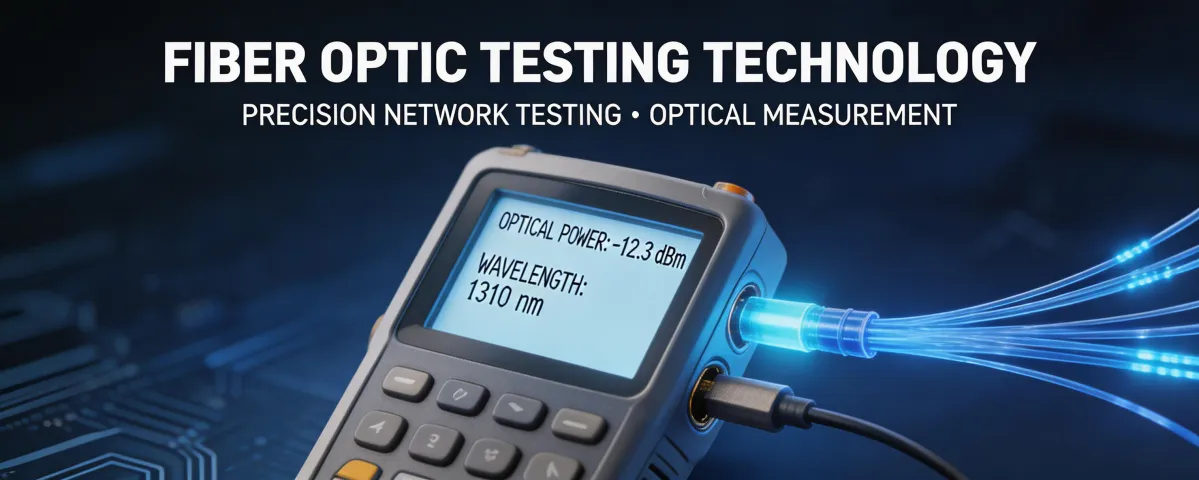
I'm the procurement manager at a 70-person network installation company. I've managed our test equipment budget (roughly $90,000 a year) for 8 years, negotiated with 15+ vendors, and logged every capital purchase in our cost tracking system. So when someone asks me whether to buy EXFO testing equipment or a 117 multimeter, I don't answer with a brand loyalty speech. I answer with a spreadsheet.
This article is not a press release. It's a comparison between two very different tools that both show up in my expense reports: EXFO testing gear and the humble 117 multimeter.
Why I'm Comparing a $10,000 Tester and a $200 Multimeter
At first glance, this seems unfair. A Fluke 117 multimeter is a hand-held electrical tester. An EXFO OTDR is a fiber-optic diagnostic platform. They cost different amounts, they do different things, and one doesn't replace the other. So why compare?
Because a lot of network technicians and buyers treat them as alternatives when the budget gets tight. I've seen teams try to diagnose a dark fiber link with a multimeter, then complain that 'EXFO testing is too expensive.' The real issue is they're comparing tools from different categories.
In my procurement process, every equipment decision comes down to total cost of ownership (TCO), not sticker price. TCO includes the purchase price, training time, calibration, maintenance, and the cost of being wrong. Let's run that comparison across three dimensions.
Dimension 1: What Each Tool Can Actually See
This is where the gap is largest. According to EXFO's product documentation (exfo.com), an OTDR sends optical pulses into a fiber and measures backscattered light to locate events like splices, connectors, and breaks. EXFO test equipment also includes optical loss test sets, PON power meters, and DWDM channel checkers. These measure optical power, insertion loss, return loss, and wavelength.
A 117 multimeter measures voltage, resistance, and continuity. That's it. It's fantastic for electrical work—checking a power supply, testing a copper pair, or confirming a ground. But it has no way to 'see' light in a fiber. No matter how carefully you hold the probes, you won't get a dB reading on a dirty connector.
Here's the surprising part: the expensive EXFO gear is also the wrong tool for purely electrical network faults. If a switch port is dead because of a bad ground or a shorted PoE line, a 117 multimeter will find it faster and more directly than an OTDR ever will. The right tool depends on the medium you're supporting.
Conclusion: For fiber networks, the 117 multimeter is not a budget alternative to EXFO test equipment—it's the wrong category. For copper and electrical work, the reverse is true.
Dimension 2: Total Cost of Ownership, Not Sticker Price
Let's talk numbers. A Fluke 117 multimeter costs about $200 from major tool distributors (based on online distributor listings, January 2025; verify current pricing). EXFO testing equipment depends on the configuration. Based on quotes I collected in Q4 2024, a basic EXFO OTDR starts around $6,500, and a full DWDM-ready test setup can run $25,000 or more.
So the EXFO unit costs 30 to 100 times more. If you're only looking at unit price, the decision looks obvious. But my cost tracking system tells a different story.
In 2023, our fiber team was using a cheap continuity tester and misdiagnosing a couple of bad splices as 'bad fiber' from the provider. Each mistake meant a repeat truck roll and a $400 service credit to the customer. By Q3, those credits totaled $8,600. We bought an EXFO optical loss test set for about $7,200. Within four months, the repeat visits dropped by roughly half. The equipment essentially paid for itself.
That's not a fantasy. That's how the TCO model works: the cost of being wrong is part of the price.
Another expense I've seen ignored: calibration and firmware. The EXFO quote included calibration for the first year. Another vendor (not EXFO) had a lower base price, but the calibration plan, software modules, and a mandatory training day pushed the total to within 3% of EXFO. So glad I asked for a line-item breakdown. We were one purchase order away from a bare-bones unit that wouldn't have done what our customer contract required.
Conclusion: The 117 multimeter is the TCO winner for electrical-only troubleshooting. For fiber network testing, a cheap tool is the expensive choice.
Dimension 3: Learning Curve and the 'How to Read a Multimeter' Question
Let's be fair to the 117. It's much easier to learn. If you're new to it, here's how to read a multimeter: set the dial to V for voltage, Ω for resistance, or the continuity symbol. Plug the black lead into COM and the red lead into the VΩmA jack for these functions. For DC voltage, touch the black probe to the negative side and the red probe to the positive side, then read the number on the display. For resistance or continuity, make sure the circuit isn't powered. If you're measuring current, use the separate A jack and break the circuit—that's a different setup.
That's about 15 minutes of training. EXFO testing equipment, on the other hand, has a real learning curve. A field tech needs to understand OTDR trace interpretation, event dead zones, wavelengths, launch cables, and connector cleanliness. Our internal training for EXFO gear runs about two days, plus another week of supervised fieldwork.
But here's the uncomfortable truth: that learning curve is a feature, not a bug. The 117 is easy, but it can give a false sense of confidence when someone uses it in a fiber context. The most frustrating part of watching a technician use a multimeter on a fiber splice tray is that they're not stupid. They're just missing the right tool.
Honestly, I'm not sure why so many fiber crews still carry multimeters as their default diagnostic tool. My best guess is habit—it's a familiar tool that costs little and works in many electrical situations. But for network test equipment, 'easy to read' matters less than 'can actually measure the medium you're troubleshooting.'
Conclusion: The 117 multimeter wins on simplicity. EXFO testing wins on relevance for optical networks.
So Which One Should You Buy?
Here's the practical decision rule I use when reviewing purchase requests:
- If your team only works on copper, Ethernet, and electrical circuits, buy the 117 multimeter. It's the right tool, and the low price leaves room for a good cable certifier later.
- If you support fiber networks—even a small PON or a campus backbone—budget for EXFO test equipment. Buy a basic OTDR or optical loss test set, and use the multimeter for the electrical parts around it.
- If you're in a mixed environment, don't frame it as an either/or. The TCO model says you need both. The question is whether you justify the optical tester now or after the next $8,000 round of repeat visits.
If you're a cost controller like me, start by calculating what a wrong diagnosis costs you. Look at truck rolls, customer credits, and weekends of rework. Then compare that number to the price of real fiber test gear. That number usually makes the EXFO decision way easier.