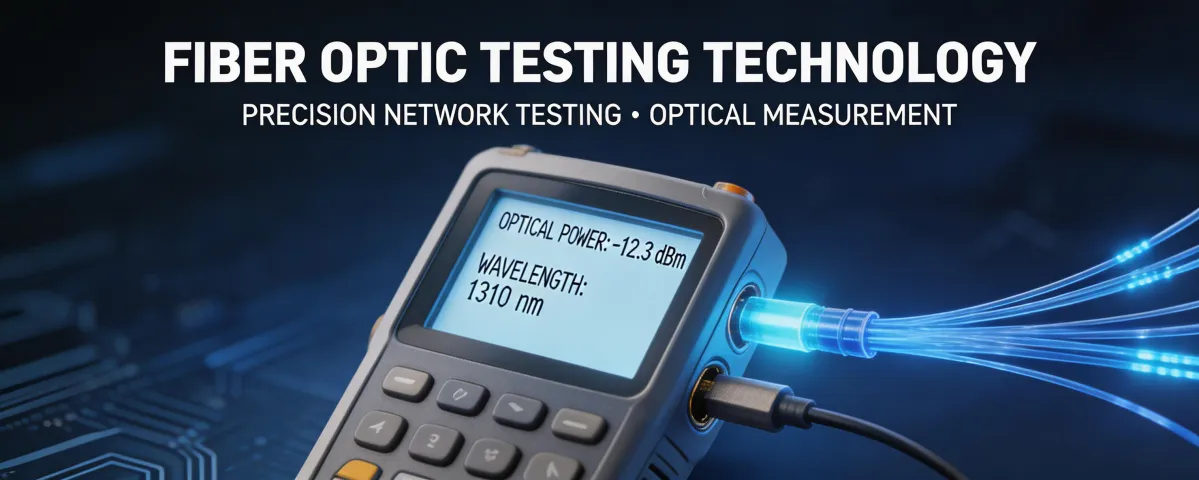
I manage test-equipment purchases for a 42-person fiber-optic contractor. Over the last six years, I have tracked about $180,000 in spending on OTDRs, light sources, power meters, scopes, and—yes—multimeters. When we budget for a new field crew, the two EXFO tools that always come up are the EXFO MaxTester 945 and the EXFO FiberScope. This is how I compare them when the CFO asks for a number instead of a vibe.
What I am comparing and why
The MaxTester 945 and the FiberScope solve different problems. The MaxTester 945 is a multi-function optical tester: OTDR, light source, power meter, and visual fault locator. It tells you where light stops. The FiberScope is a high-magnification inspection probe. It tells you why light stops. Most buyers focus on the MaxTester because it is the expensive box with the impressive screen. They completely miss the scope that catches the most common cause of field failure: the connector end-face.
It may be tempting to compare their prices and pick one. That is an oversimplification. The real question is not which box is better; it is which failure mode costs you more in rework and truck rolls.
Dimension 1: What the MaxTester 945 sees vs. what the FiberScope sees
The MaxTester 945 is our certification backbone. When we hand over a completed 12-fiber run, the client wants a trace that proves length, loss, and splice quality. The MaxTester does that in one test. It also lets a single tech test PON splits and locate a break 10 km away. If I had to certify fiber with one tool, this is it.
The FiberScope looks at the end face of a connector at high magnification. A single-mode core is about 9 microns wide—a speck of dust looks like a boulder to it. Dirty connectors cause reflections, insertion loss, and intermittent links. The FiberScope shows contamination before it becomes a problem. In our workflow, every connector gets cleaned and inspected before it is plugged into the MaxTester. That simple rule stopped a whole category of mystery failures.
My conclusion on this dimension: The MaxTester finds the problem. The FiberScope prevents the problem. If your team is troubleshooting, you need the finder. If your team is installing and terminating, you need the preventer.
Dimension 2: Total cost of ownership—the part I obsess over
Here are our numbers, not a brochure. The MaxTester 945 with the iOLM module, hard case, and one-day training cost us $5,150. Annual calibration is around $700. We have had one screen repair at $480. Over five years, that is roughly $8,800, or $1,760 per year.
The EXFO FiberScope 8K with a full tip kit cost us $2,300. We bought it in Q2 2024 and have not had a repair or calibration cost yet. Replacement tips are $120 each, and we wear them out about once a year. That is a much lower TCO. But the bigger number is what the scope saved us in the first month: our techs found 14 contaminated connectors on runs that failed acceptance. At $125 per truck roll and $80 per wasted service call, that was roughly $2,800 of avoided rework. The scope paid for itself in month one.
A few people will say I am counting callbacks that were not totally avoidable. Maybe. But when I audit our records, the connector is dirty in about 60% of our fails-after-install tickets. A scope catches that before the client sees it. I should also note these are our field numbers. A network operator with an in-house calibration lab might see a different picture. But if you are a contractor like us, rework time is the largest cost line in the spreadsheet.
Dimension 3: Workflow fit—and the real cost of a wrong tool
The MaxTester has a learning curve. Even with the one-button iOLM, a new tech can produce a misleading trace if the index of refraction is wrong. The FiberScope is nearly foolproof with automated pass/fail, which is a big deal when you staff overnights and weekends.
Here is a real example. In Q2 2024, we kept seeing a 0.4 dB loss at a patch jack on a 3210 distribution panel. The MaxTester told us exactly which connector was bad. Three times, a tech re-terminated the drop at the other end. The loss stayed. Finally, someone put a FiberScope on the jack and saw a cracked ferrule inside the jack itself. Replacing that one jack cost $40. The three re-termination trips cost about $1,100 in labor and overtime. The scope turned a three-day headache into a 20-minute repair. That is why our acceptance docs now reference IEC 61300-3-35, and the FiberScope's pass/fail feature is how we enforce it in the field.
What about the best multimeter?
I keep seeing 'best multimeter' in search results when people ask about fiber test gear. Here is the blunt cost-controller version: a multimeter is not a fiber tester. The best multimeter on the market measures volts, amps, and ohms on copper. It cannot see a 9-micron core, it cannot measure optical loss, and it cannot detect a cracked ferrule inside a jack. If you work on hybrid plant, buy a good multimeter for the copper side. But do not let it replace a FiberScope or a MaxTester. That is the kind of false economy that created a $1,200 redo for us when we tried to save money by skipping a scope in my first year.
In my first procurement, I made the classic mistake: I approved the MaxTester and skipped the scope to stay under budget. I knew better, but I thought 'what are the odds?' The odds caught up. The $2,000 saved turned into a $2,800 rework and a client who started watching our process a lot more closely.
Bottom line: which one should you buy first?
If you are certifying outside plant or building new fiber, buy the EXFO MaxTester 945 first. It is the proof-of-work tool. If your work is mostly MACs, troubleshooting, or PON drops, buy the EXFO FiberScope first. It is the prevention tool that finds the actual cause of most failures.
If you already have one of the two and someone asks you to buy the best multimeter instead of the missing tool, say no. Get the missing EXFO tool first. In a perfect budget, you own both. That is not a vendor pitch—our TCO spreadsheet says the pair is cheaper than one after-hours truck roll after a callback. Or rather, it is exactly the same as one bad night of overtime. And we all know which one is worse.