It was 4:47 p.m. on a Friday in March 2024 when the phone rang. I remember the time because it was the exact moment I almost lost my weekend.
The caller was a project manager for a fiber contractor. 'Please tell me you have the EXFO OTDR manual,' she said. 'Our tech is on site, he can't get the OTDR going, and he used his Klein multimeter to test the fiber. It reads zero. The network needs to be verified by 7 a.m. tomorrow.'
I have mixed feelings about calls like this. On one hand, I genuinely like solving nasty field problems. On the other, I know that when someone asks for a manual at 4:47 on a Friday, the manual is rarely the real problem.
In my role supporting EXFO customers, the first thing I ask in any emergency is for the model number. It has saved me more times than I can count. But this time, the model number only told me where to find the manual. It didn't tell me why anyone would test fiber with a Klein multimeter.
The EXFO OTDR Manual Was the Easy Part
Finding the manual was simple. The tech read the model number printed on the top of the unit, I found the right EXFO OTDR manual on the support portal, and the dispatcher sent the PDF to the tech's phone. Four minutes, maybe five. That part went better than I expected.
The part that did not go well was the test itself. The tech had never operated that OTDR. Worse, he had been 'checking the fiber' with his Klein multimeter before I got involved.
In fairness, Klein makes solid gear. I own a Klein multimeter. It lives in my garage, and I trust it for electrical work. But an EXFO meter and a Klein multimeter are not interchangeable. The real comparison is not EXFO vs Klein multimeter. It is an optical measurement device versus an electrical measurement device.
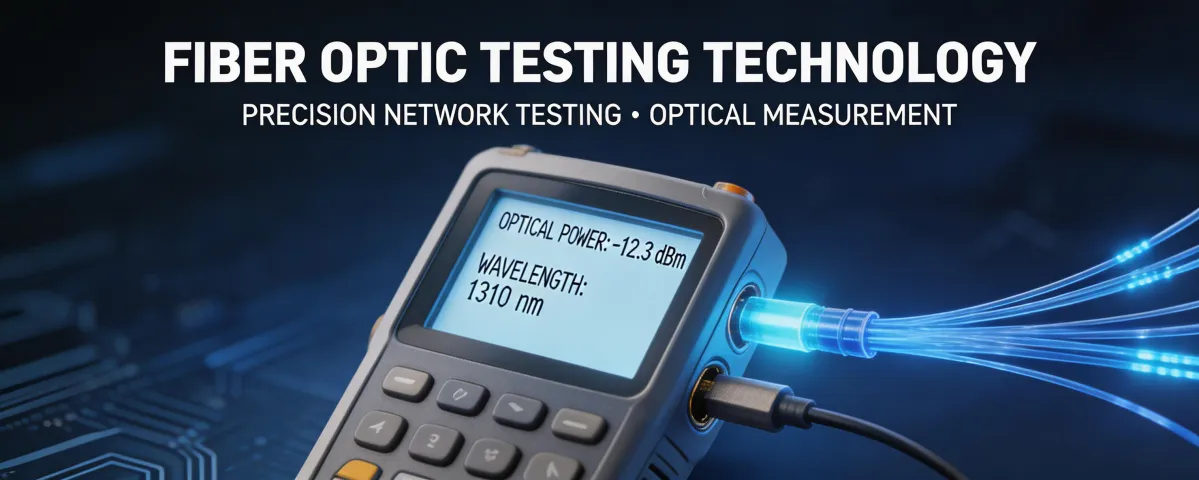
An EXFO meter reads optical power in dBm or milliwatts. A Klein multimeter reads voltage, current, and resistance. When a fiber is carrying light, a multimeter sees nothing. Zero. That does not mean the fiber is dark. It means the multimeter does not measure light.
According to The Fiber Optic Association (FOA), an optical loss test requires a light source and an optical power meter calibrated to the same wavelength. A digital multimeter does not detect light, so it cannot perform that measurement.
This is the comparison I always offer: using a blood pressure monitor to check your temperature will give you a number, but not one you should trust. Same idea here. The Klein multimeter was the right tool for a different job. On this job, it was a distraction.
I still had a little doubt, honestly. Part of me wondered if he had an optical-to-electrical adapter clipped onto the meter. I asked him to send a photo of the display. It was set to DC volts. That settled it.
'Put the multimeter down,' I said. 'We'll do this with the OTDR.'
What Happened After I Stopped the Bleeding
Once the manual was on the tech's phone, he started reading out loud. That helped. He knew basic fiber concepts, but he had never used this particular EXFO model. I walked him through the setup in a way that followed the manual but didn't drown him in menus.
Here is the part I still think about: the fiber was probably healthy the whole time. The multimeter's zero was not a diagnosis. It was a dead end. The real failure was the process, not the light.
The first step was cleaning. The OTDR patch cord had dust on it, and the connector on the wall panel looked worse. I told him to clean both before connecting anything. The EXFO OTDR manual says the same thing, in less colorful language. He found a click-clean ferrule cleaner in the OTDR case, which was a relief. A dusty connection can easily add 0.5 dB or more and make a healthy link look broken.
Then we set the test wavelength. The OTDR defaulted to 1310 nm, but the client spec required testing at 1550 nm as well. That's not an arcane detail; it changes the measurement. We ran both wavelengths, with enough averaging to get a reasonable trace.
On the first fiber, the trace showed a reflection at the far end that looked like a bad event. I asked the tech to repeat the test with a launch cable before making any judgment. When he did, the event disappeared. That is the kind of thing that would have sent him hunting for a splice that didn't exist.
The last fiber passed at 11:20 p.m. I didn't relax right away. Even after he saved the traces, I kept second-guessing. What if he had selected the wrong averaging time? What if the connector got dirty again between the cleaning and the test? The next morning, the report came through clean, and the network was accepted on schedule.
What I Would Tell Another Tech in That Truck
First, stop and ask what the tool is actually measuring. A Klein multimeter is not an EXFO meter. An EXFO meter is not an OTDR. Each instrument answers a specific question. Using the wrong one creates data that looks like evidence but isn't.
Second, if you are about to work on a live fiber with a tool that cannot detect light, stop before you touch anything. Call for help. The customer won't remember that you asked a dumb question; they will remember that you flagged the risk.
Third, don't rely on memory for OTDR settings. Keep the EXFO OTDR manual accessible on your phone, or download the quick start card. I have a personal policy now: every field kit gets a binder. Nothing fancy, just a one-page setup reminder and a list of common wavelengths. It has saved us more than once. (Note to self: add the cleaning routine to that card next.)
The job ended on time because a tech stopped and said he didn't know instead of pretending he did. That is rare, and it should not be. I'd rather spend ten minutes on the phone with someone than receive a panic text at 3 a.m. about a cut cable. This time, the panic stayed at four minutes and forty-seven seconds on a Friday. I can live with that.