The False Comfort of Voltage Readings
When a link drops at 2 a.m., the first device people grab is a digital multimeter. It makes sense. It is the universal tester. You check power supplies, fuses, and grounds. You watch the display settle on 12.1 volts and tell yourself the problem can't be power. Then you go deeper into hardware. Then you call the network team. And eventually you find out the real problem was invisible to a voltmeter the whole time: contamination on a fiber connector that turned a -22 dBm PON optical signal into -29 dBm at the ONT.
I've been on maybe 300 outage calls. Maybe 250, if I'm honest—I'd have to check the ticketing system. In my role coordinating fiber network escalations, I've watched this pattern repeat enough times to know one thing: the attack surface is optical, and we keep diagnosing it with electrical tools.
The Problem Beneath the Problem
Here's what a multimeter cannot see. Fiber networks transmit information as light, so their failure modes are optical. You can measure all the volts and amps in a cabinet and still miss the cause of an intermittent link because the reason is sitting on the face of a connector.
The deeper problem is that the most fragile part of a fiber network is not the laser. It is the connector. It gets touched, pulled, dusted, and damaged. It is the point where light crosses from one cable to another, and it is the place where contamination usually wins. Based on my internal data from 200+ escalations, connector contamination showed up in roughly a third of chronic link problems.
Connectors: The Smallest Part with the Biggest Failure Rate
Fiber connector contamination is not a rumor or a scare campaign. A scratch on the end-face, a dust particle, a drop of oil from a fingertip—these are often the difference between a stable link and a marginal one. According to the IEC 61300-3-35 standard (iec.ch), connector end-faces have defined pass/fail limits for contamination. The standard exists because a clean-looking connector is not always clean.
When a network is intermittent, inspect the connector ends before you replace a single optical module. I still kick myself for the times I ignored a dirty connector and spent hours swapping hardware that was never broken. If I'd started with an inspection probe, I would have found the issue in about twenty minutes instead of four hours.
The EXFO Light Meter Is the Multimeter for Photons
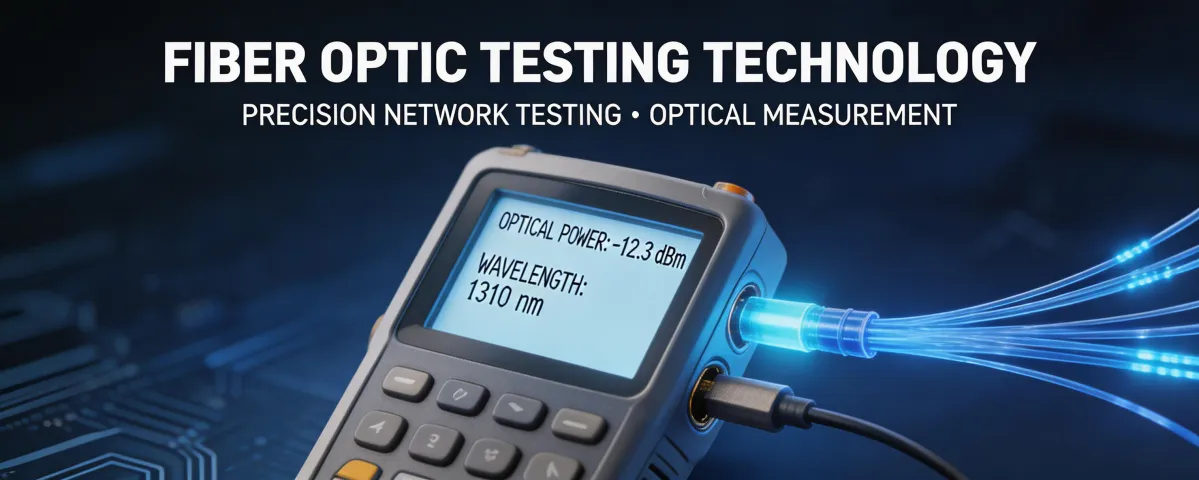
If you want a quick answer to is there enough light at the receiver, an EXFO light meter is the tool to use. It measures absolute optical power in dBm at the point you connect it. On a PON network, that is the number that matters at the ONT: after splitters, after fusion splices, after every connector. If the power at the ONT is below the receiver sensitivity, the link won't sync. It might sync and then drop under load.
A multimeter measures voltage and current. An EXFO light meter measures optical power. They sound similar because both are handheld meters, but they are not interchangeable. According to EXFO's product documentation (exfo.com), its light meters support absolute optical power pass/fail measurements for the wavelengths used in PON networks. You don't test optical fiber with a voltmeter, and you don't test a 12 V DC power supply with a light meter.
Spectrum Analyzers for Networks That Have Gotten Denser
What was best practice in 2020 may not apply in 2025. A total power reading was enough on some older networks, especially single-channel or coarse WDM systems. But today, dense wavelength division multiplexing is common. An 80-channel system can show healthy total power while individual channels fail. That is why an EXFO spectrum analyzer has become a normal part of field triage, not a lab-only instrument.
An optical spectrum analyzer distinguishes individual wavelengths, measures channel spacing, per-channel power, and optical signal-to-noise ratio (OSNR). According to EXFO (exfo.com), its optical spectrum analyzers are built for WDM and DWDM networks and measure per-channel power and OSNR. When a high-speed channel starts to break because a wavelength drifted toward the edge of its grid, a light meter might miss it. The spectrum analyzer sees the whole story.
The Cost of Guessing Wrong
The most frustrating part of this pattern is that the solutions are not exotic. You'd think written test procedures would prevent the same issue, but they only work when someone actually follows them.
In March 2024, a regional healthcare network had a scheduled upgrade due in 36 hours. A remote site was linking at 10 G but with a rising error rate. The team tested the transceiver, changed the SFP, switched patch panels, and ran a speed test. The errors kept coming. Meanwhile, the hospital's imaging system was using the link and no one wanted to take it down. I was brought in, triaged the span with an EXFO light meter, and found a launch cable that was already below spec before it reached the real drop. The culprit was a bad connector at the wall jack. It had been terminated by a contractor who didn't use post-polishing inspection, and in 2025 we were still paying for that decision.
When you guess wrong, the costs are not just overtime and vendor fees. The first outage is the original failure. The second outage is your team's time after the fact. I've seen a single dirty connector generate three separate tickets and four truck rolls over nine days. That is the real price of the wrong first test.
The wake-up call in November 2023 changed how I think about test gear. A link dropped for a few seconds every morning at 3:40 a.m., exactly when the client ran a backup job. Everyone suspected the network team, then the server team, then the storage switch. It took two days to find a small contamination on a fiber connector at the patch panel. (Should mention: the backup job happened to run at the same time of day the cabinet warmed up, so the link loss appeared only when the connector ferrule expanded slightly.) The multimeter had proved the power supply was fine on every single visit.
The Diagnosis Tool Order
Here's what I use now, and honestly it has turned four-hour outages into 45-minute repairs more than once.
- Inspect every connector in the suspect path with a fiber inspection probe. Clean it if needed. Use automated pass/fail against IEC 61300-3-35 if your probe supports it.
- Measure the optical power with an EXFO light meter at the receiving end. Compare the reading to the expected minimum and check how much overhead you have. If you have 1 dB of margin, look deeper for mechanical stress. If you have -28 dBm on a GPON ONT, stop and work back from the splitter.
- For DWDM systems, connect an EXFO spectrum analyzer and look at each channel. Check center wavelength, power per channel, and OSNR. Total power does not protect you from adjacent-channel crosstalk or a drifting laser.
- Use a digital multimeter only for the power integrity side of the network: verify DC supply voltages, battery voltage, grounding continuity, and AC input. The multimeter has a job. It just is not an optical tester.
How to read a multimeter is not a dark art: set the dial to the DC voltage position, insert the black lead in the COM input and the red lead in the VΩmA input, touch the probes to the two test points, and read the value on the display. Choose a range larger than what you expect if it is a manual-ranging meter. This is worth knowing—you just need to know when you are supposed to use it.
Keep the Offense on the Field
Since 2023, my internal policy is simple: inspect first, measure second, replace last. The fundamentals have not changed. Clean connectors, calibrated test gear, and measurement discipline are still the core of network reliability. What has changed is the execution. Testing in 2025 means using more than one meter. It means knowing that a connector can fail a network just as hard as a failed power supply, and that a light meter and a spectrum analyzer are the real troubleshooting partners.
Trust me on this one. You can keep the multimeter in your bag. I am not telling you to throw it out. But next time a link drops, reach for an EXFO light meter before you start reading voltage. Give the fiber path a chance to tell you its story first. It usually will.