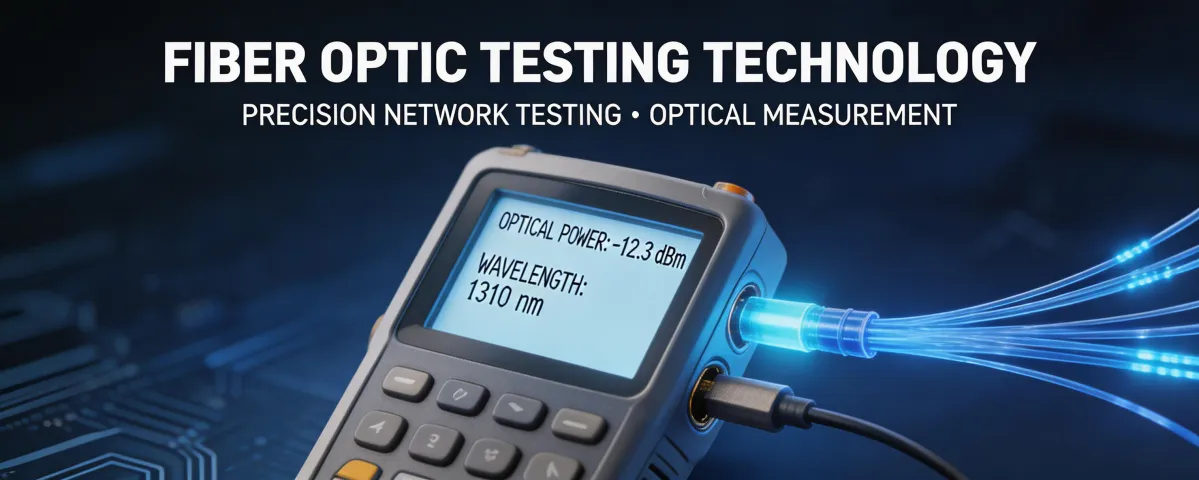
I get it. You look at the price tag on an EXFO MAX-730C and your first thought is, "Do we really need this?" I've been there. As a quality manager in the optical networking world, I've spent years on both sides of that question—reviewing specs, approving purchases, and then dealing with the fallout when a cheaper decision turned sour.
This post isn't about defending premium pricing. It's about the math most buyers miss. The one that made me change how I evaluate test equipment.
The Surface Problem: "Why Does a Network Tester Cost This Much?"
When you're buying a network tester for the first time—or replacing an old one—the sticker shock is real. A serious OTDR or DWDM channel checker can easily run into five figures. And if you've got a limited budget, a budget-friendly option looks tempting. The spec sheet says it works. The sales rep says it meets industry standards. So why pay more?
I've asked myself that exact question. Back in Q1 2024, I reviewed three quotes for a portable network tester. The cheapest was 40% below the EXFO equivalent. My first instinct was to save the money. But that project taught me a lesson about hidden costs.
What's Actually Driving the Cost
The gap in price isn't about brand markup. It's about the things you can't see in the sales brochure. Let me walk you through the parts that caught me off guard.
Measurement Accuracy and Repeatability
A network tester isn't a hammer. It's a measurement instrument. If it gives you a result that's 5% off, you might accept a marginal fiber link that should have been rejected—or reject a link that's actually fine. Both outcomes cost money. In my experience, precision is the first thing to go when manufacturers cut corners. The "accuracy" number on a spec sheet means nothing if there's no calibration traceability behind it.
I didn't fully understand this until we ran a side-by-side comparison of two OTDRs. Same fiber, same settings, same day. The EXFO unit on loan showed a minor splice loss of 0.04 dB; the budget unit showed a clean trace. If we'd relied on the budget unit, we would have lit up a link with a known fault. That contrast changed my thinking.
Here's the kicker: we didn't have a formal benchmark process back then. That was half the problem. We bought the cheap unit because nobody forced the vendor to prove its specs against a calibrated reference. Now every candidate has to pass the same side-by-side test before I sign off.
Software and Firmware Support
Hardware gets you halfway. The software that interprets the trace, manages the data, and integrates with your existing reporting is the other half. Some vendors treat firmware updates as a revenue stream. Others treat them as a bug fix. Over a 5-year lifespan, that difference impacts your workflow every week. Honestly, the EXFO 930 series I've used has had 5 major software upgrades since 2022. That's not a nice-to-have—it's how the instrument stays useful as protocols evolve.
Most buyers never check whether the vendor's software will export test results in a format your customer accepts. I've seen project delays caused by a tester that only output proprietary PDFs. That's a hidden cost you don't see until you're on the deadline.
Build Quality and Tolerances
Field testers get dropped, banged, and used in rain. The enclosure, connectors, and internal architecture matter more than most people think. I once saw a cheap tester fail on a humid construction site; the internal optics fogged up, and the readings were nonsense. The vendor said it was "outside the operating range." That same week, a 6300-series unit worked fine in the same conditions.
You cannot put a dollar figure on durability in a spec sheet. But when you're standing in a mud pit at 10 PM, about to sign off on a fiber backbone, you'll know exactly what it's worth.
The Real Cost of a Bad Test
Let's talk about what a wrong test result actually costs.
Our team once accepted a batch of fiber terminations based on a budget tester's pass readings. Six months later, we saw intermittent packet loss on that route. Retesting with a calibrated unit found several connectors with excessive back reflection. The customer's service-level agreement was violated, and we had to send a crew out in the middle of a peak traffic period. The total cost? Nearly triple the price difference between those testers.
That's the hidden math. A $500 saving on the purchase becomes a $1,500 redo when the test wasn't accurate enough to catch a real problem. Per FTC guidelines (ftc.gov), claims about product performance need to be substantiated. Do your own verification before you trust a spec sheet.
The Most Common Mistake I See
Maybe the biggest misconception is that "all testers are the same as long as they pass the same test." Not true. Tolerances, calibration, and measurement algorithms vary significantly. A lower-priced unit might have accuracy stated as "±0.05 dB" while the EXFO MAX 730C states "±0.02 dB." Over many tests, that 0.03 dB difference changes which fiber segments you flag.
There's also the issue of certification. If you're a contractor working with carriers, your results have to be credible. When the auditor asks which tool you used, an uncalibrated budget unit won't cut it. In one tender, we lost a contract because our competitor listed traceable calibration on every instrument—we couldn't prove the same.
A Smarter Way to Buy: Think TCO, Not Sticker Price
So what should you do? Start by calculating total cost of ownership over 3–5 years. Include:
- Calibration and repair costs—some vendors offer flat-rate plans; others charge per incident.
- Software updates and support—factor the cost of keeping the unit current.
- Productivity impact—how long does each test take? Is the UI easy for your technicians?
- Risk cost—the price of missing a fault that causes a network outage.
In my experience, the EXFO 930 and MAX-730C have consistently lower TCO than cheaper alternatives, because the accuracy reduces false passes and the support is fast. I'm not saying they're perfect—we've had minor issues—but they never cost us an outage.
And if you're wondering about "NXP vs" other chipsets out there, that's a different debate. What matters in a network tester is how it handles the fiber itself.
Bottom line: Don't buy a network tester on price alone. Buy it on the cost of being wrong. The extra money is insurance against the failure you don't see coming.