I'm the office administrator for a 75-person fiber contracting company. I manage test equipment purchasing—about 60 to 80 orders a year, roughly $180,000 across 11 vendors. I report to both operations and finance. I don't certify fiber splices or read OTDR traces. I sign POs, process repair claims, and see which tools actually come back in one piece. So when our field team asked me to order a PON power meter, I ended up comparing EXFO PON power meters, the EXFO FIP-435B, the EXFO 2780, the EXFO 3210, and Klein multimeters. If that sounds like comparing apples to socket sets, you're not wrong.
This guide is for other non-engineers who have to buy test equipment without a telecom engineering degree. I'm going to compare the EXFO PON power meter vs Klein multimeter from a procurement perspective: what each tool measures, how calibration works, what field life looks like, and why total cost of ownership matters more than the first number on the quote.
How I compared them
I used a simple framework:
- Measurement purpose — what the tool actually reads
- Accuracy and calibration — where the number comes from
- Field durability — what happens after the first drop
- Training and support — who uses it and how long it takes to learn
- Total cost of ownership — the full cost, not the invoice cost
And a quick note before the dimensions: if you searched for “exfo pon power meter,” “exfo fip-435b,” or “2780/3210,” those are not the same thing. The FIP-435B is a fiber inspection probe, not a power meter. The 2780 and 3210 are older EXFO handheld units that appear in used equipment listings. For PON signal verification, you want a PON power meter. For connector cleanliness, you want the FIP-435B. For electrical troubleshooting, you want the Klein.
Dimension 1: What the tool actually measures
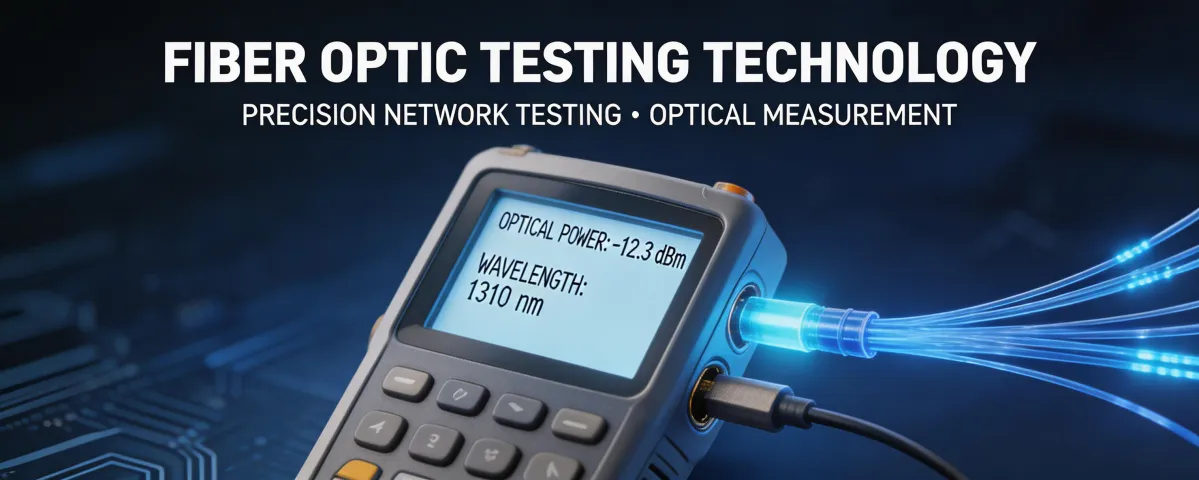
It's tempting to think “any meter works.” But a Klein multimeter reads voltage, current, and resistance in electrical systems. An EXFO PON power meter reads optical power at PON wavelengths—typically 1310 nm upstream, 1490 nm downstream, and 1550 nm for video overlay, depending on the model (Source: ITU-T G.984/G.987 standards, accessed January 2025).
This sounds kind of obvious until you're in a warehouse at 6 a.m. and the EXFO unit is missing. One of our technicians once grabbed a Klein multimeter to “check a fiber” because it was the only meter on the truck. It didn't give a false reading. It gave no reading. That's the expensive kind of failure: not a bad number, but a missing signal and a rescheduled activation.
What most people don't realize is that a multimeter might show “dBm” for audio work, but that doesn't make it an optical power meter. The sensor, the connector, and the calibration chain are all different. The EXFO FIP-435B adds another layer of confusion because—while it's compact and from the same brand—it inspects the polished end-face of a fiber connector and compares it to IEC 61300-3-35 pass/fail criteria. It's not a replacement for a power meter. It answers a different question.
Dimension 2: Accuracy and calibration
For an electrical multimeter, calibration is a “nice to have” until something goes wrong. For a PON power meter, calibration is the whole point. A 1 dB error at 1490 nm can turn a good service activation into a repeat truck roll. EXFO publishes accuracy specs for its optical instruments. Klein multimeters are built to electrical safety standards like CAT III/CAT IV, not optical standards. Both are good at their jobs; they're just not the same job.
In 2024, I rejected a used EXFO 2780 because the seller couldn't provide a calibration certificate. The unit looked clean and the price was good, but without the paperwork our QC engineer wouldn't touch it. That was not bureaucratic stubbornness. It was the lesson from a previous purchase: the $500 quote turned into $800 after calibration, repair, and shipping, plus the time I spent trying to get a clear answer from the seller. The $650 all-inclusive quote with the certificate included was actually cheaper.
Here's something vendors won't tell you: the calibration interval on most test equipment is the safe maximum, not the expected failure point. If you're buying a used EXFO 3210 or any refurbished optical meter, ask for the last calibration date and the cost of the next calibration. Based on quotes I received in Q3 2024, a professional lab calibration for a handheld optical meter can cost between $150 and $400. That's not a hidden fee—it's part of total cost of ownership.
Dimension 3: Field durability
Both EXFO and Klein build field tools that survive drops, dust, and weather. Klein multimeters have a strong reputation on electrical crews. EXFO PON power meters are designed for fiber technicians, with rubber boots, straightforward button layouts, and connectors that protect polished ferrules. If I'm buying for an electrician, I buy Klein. If I'm buying for a PON installer, I buy an EXFO PON power meter.
Here's the counterintuitive part: the cheaper Klein multimeter may be physically tougher than the EXFO unit in some common field tests. But durability only matters if the tool can do the job. A tough multimeter that can't read optical power has a total cost of ownership equal to the failed service call it never prevents. So don't let the rugged case make the decision for you.
Dimension 4: Training and support
Klein multimeters are almost self-explanatory for anyone with basic electrical experience. EXFO PON power meters are also designed to be simple, but the technician needs to know the right wavelength, connector type, and what a passing upstream signal looks like. The FIP-435B adds another skill: interpreting fiber end-face images and pass/fail results.
When I put together a PO for test equipment, I add 30 minutes of training time into the cost. That's not an insult to our technicians. It's a recognition that a tool is only as good as the procedure around it. A $1,400 EXFO meter without any training is an expensive paperweight. A $100 Klein multimeter used for fiber work is a false sense of coverage. Both are waste.
Dimension 5: Total cost of ownership
This is the dimension that changed how I buy. When I took over purchasing in 2020, I compared sticker prices. Now I calculate five costs: purchase price, accessories and adapters, calibration and repair, training and downtime, and the cost of a wrong reading. The last one is often the biggest. During our 2024 vendor consolidation project, I used the same calculation to cut duplicate purchases and standardize on fewer, better-supported tools. It saved us more than any cheapest-quote comparison ever did.
Let me put it in numbers. As of January 2025, new EXFO PON power meters can range from roughly $1,000 to $2,500 depending on the model and included accessories; Klein multimeters range from about $30 to $300 (based on EXFO and Klein Tools product pages and distributor listings; verify current pricing). The dollar gap can be more than $1,000. But one failed PON activation—because a technician couldn't measure upstream power—can easily cost $500 to $1,500 in labor, rework, and customer credits. If the cheap meter causes one missed test, the savings disappear. If it causes two, the expensive meter was the cheaper option.
The same logic applies to the EXFO 2780 and 3210 on used equipment sites. A $350 used EXFO 2780 can be a great value if the calibration is current and the seller accepts returns. A $350 used EXFO 2780 with no calibration certificate is a risk that my TCO formula doesn't like. Calculated the worst case: complete redo at $1,200. Best case: saves $400. The expected value said maybe, but the downside felt like a bad joke—especially in front of our operations manager.
Which one should you buy?
If your crews work on electrical systems, buy the Klein multimeter. It's a proven, cost-effective tool for that job. If your crews work on fiber-to-the-home or enterprise PON, buy an EXFO PON power meter (or an equivalent calibrated optical meter). If your problem is dirty connectors and intermittent loss, add the EXFO FIP-435B inspection probe—because no power meter will tell you that a contaminated connector is the root cause.
And if you're in the admin seat, don't just compare the first line of the quote. Look for the calibration certificate, ask about adapter availability, add training time, and find out what happens when the tool needs service. That's the comparison that matters.
Personally, I don't care whether a tool says EXFO or Klein on the case. I care what it costs across three years of field use. When you compare that way, the “cheap” tool becomes expensive and the “expensive” tool starts looking like the safe call.