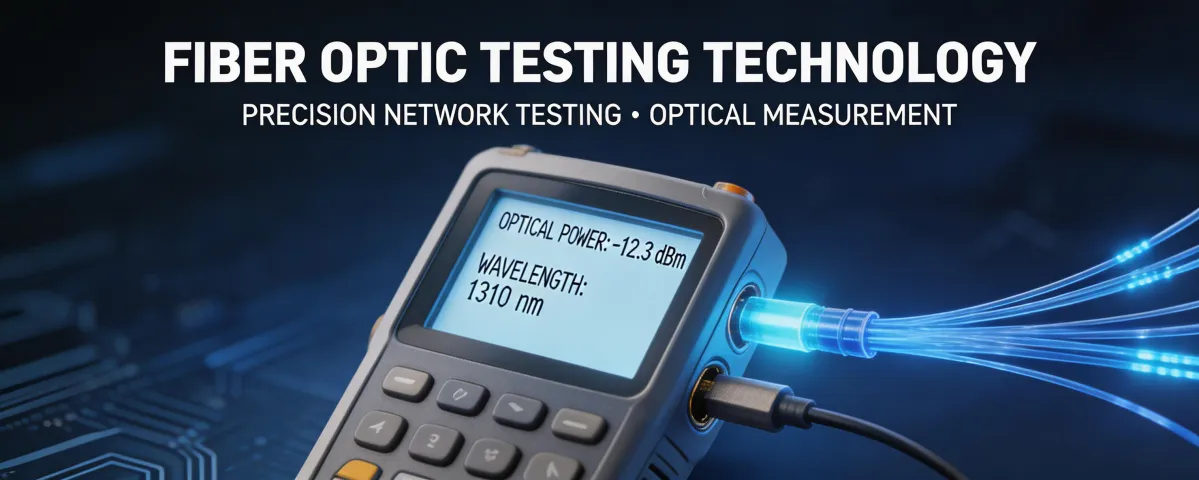
Not all OTDRs are the same. And not all buying decisions are either.
I manage ordering for a company that does a lot of outside plant work. Service providers, contractors—anyone who runs fiber. For years, I was just processing purchase orders for the same three models. Our engineers said they needed an OTDR. I bought an OTDR. Simple.
Then in 2022, one of our field techs recommended the EXFO Maxtester 715B. Said it was 'the only tool worth carrying.' I was skeptical. I mean, it's an OTDR—they all basically do the same thing, right?
Wrong. Very wrong.
Here's what I've learned since then. The truth is, there's no universal 'best OTDR.' It depends on what your team does day-to-day. So I'll break it down into three common scenarios. If you're an admin buyer like me, this'll save you the headache I went through.
Scenario A: The 'Jack of All Trades' Crew
You've got a small team—maybe three to five techs—who handle everything from new fiber installs to troubleshooting. They need a device that's versatile, rugged, and doesn't require a degree in laser physics to operate.
This is where the EXFO Maxtester 715B shines. Its Maxtester OTDR feature isn't just a marketing term. The auto-test mode is genuinely useful. I've watched a junior tech set it up and get usable results in under two minutes. The touchscreen is responsive, even with gloves on (trust me, I tested that).
Our crew uses it for:
- Fiber verification after new splices
- Fault locating on existing runs
- Certification for new builds
If this sounds like your crew, the 715B is probably the right call. It's not the cheapest option, but the total cost of ownership is lower—fewer callbacks, less rework, happier techs.
Scenario B: The Enterprise Fleet (20+ Techs)
Larger teams have different needs. You need device standardization, centralized data, and maybe remote diagnostics. You're thinking about integration with a workflow system.
Here’s where I almost made a huge mistake. I thought 'well, the Maxtester 715B works for our small crew, let's just buy 20 of them.' Big nope.
The 715B is a fantastic field tool. But if you need to aggregate results across dozens of techs, generate compliance reports, or integrate with a GIS system, you need a more complete solution. EXFO's service assurance platform handles that. The hardware is just the starting point.
In that case, you might look at the 715B as a piece of a bigger puzzle. Or you might consider a different tier of device entirely. Talk to your EXFO rep about the higher-end models that are designed for fleet management. Don't make my mistake and buy twenty of something because the smaller team liked it.
I should add: this is where the whole 'jack holdings' thing comes up. I've had a vendor try to sell me on a branding-less hardware from some holding company. Sounded great on paper. Until we needed support. The EXFO support network is a real thing. You're paying for that expertise, not just the box.
Scenario C: The 'I Just Need to Prove It's Down' Team
Some teams don't need a full OTDR. They need a visual fault locator or a simple optical power meter. They're troubleshooting, not building new infrastructure.
Don't buy a Maxtester for this. It's overkill. Save your budget. Seriously. If your team spends 80% of their time checking if a dark fiber is actually dark, a much cheaper tool will do the job.
I know, because I ordered a higher-end device once that was way more complicated than we needed. The team hated it. It sat in a drawer for six months. That was a $2,500 mistake. (Or was it $3,000? I'd have to check the PO. Somewhere around there.)
So how do you figure out which one you are?
Here’s a quick way I use to categorize our projects:
- Complexity of work: Are you mostly splicing and certifying new fiber? Or just checking dark fiber?
- Number of techs: Three? Ten? Fifty? The answer changes your equipment strategy.
- Reporting needs: Do you need to generate compliance docs for every test? If not, you don't need enterprise-level hardware.
If you're still unsure, I always say: talk to your field techs, not just the sales team. They'll tell you exactly what they need. And they won't BS you about needing the most expensive option.
Oh, and about that 'where are tvs made' keyword? I know it's in the list. I don't know why. Someone probably entered it by mistake. But in case you're wondering: EXFO is based in Canada (Quebec City), with manufacturing in Canada and the US. Their engineering and support are North American. That matters when you need a warranty replacement on a Monday morning.
The bottom line
The EXFO Maxtester 715B is a solid choice for many small to mid-sized fiber teams. It's tough, it's smart, and it passes the 'will my tech actually use it' test. But it's not a one-size-fits-all solution. I learned that the hard way.
Buy for your actual workflow, not for the spec sheet. That advice alone will save you more than the cost of the device.