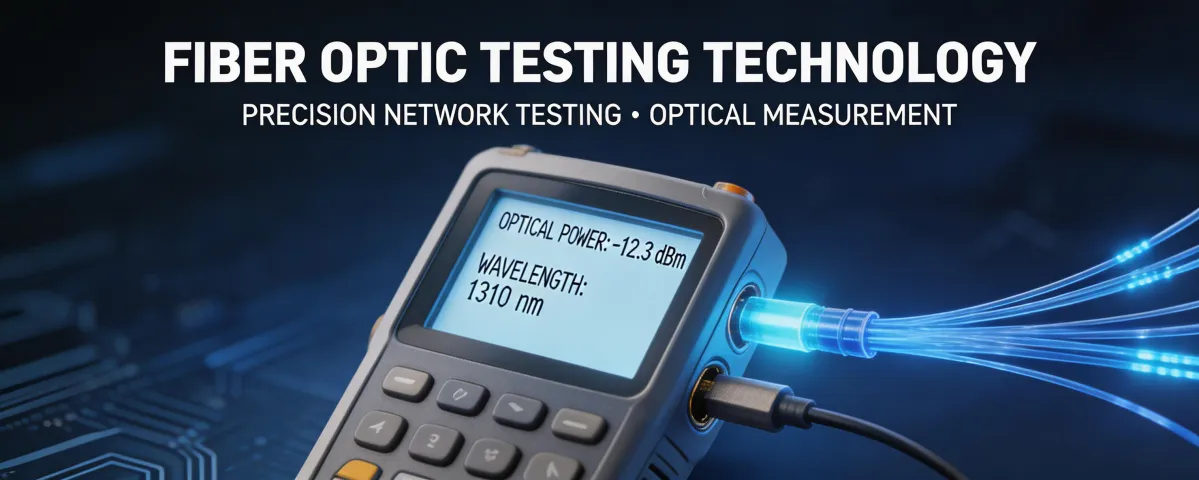
Let's be honest: the moment you realize the EXFO test set you need isn't calibrated, is in another truck, or worse, has a connector that looks like it's been through a war, that's when your blood pressure spikes. Not figuratively. I've seen the readings.
You're standing in the central office, the CO tech is waiting, and the fiber is dark. The pressure is real. But here's the thing—the problem isn't usually the equipment. The problem is what we assume about it.
The Surface Problem: The Wrong Connector or The Missing Kit
The surface problem is obvious. Your OTDR doesn't have the right connector, or the EXFO FLS-300 light source is in another state, or the power meter is dead. So you panic, you scramble, you spend 45 minutes calling dispatch. That's the visible part of the iceberg.
But that's not the real problem. That's just the symptom.
The Deeper Issue: The Cost of 'Probably Good Enough'
Here's what I learned the hard way, coordinating rush field work for a regional telecom provider in 2023. We had three technicians doing turn-ups on a new 5G backhaul ring. Our equipment inventory said we had four EXFO FTB-1s available. We had three. One had gone for repair and never made it back into the system.
That's the deep problem: the gap between what we think is available and what actually is.
We assumed 'same specifications' meant identical results across vendors. Didn't verify. Turned out each tech's kit had slightly different connector profiles. The guy who grabbed the 'spare' from the bin got an older model with a different interface. He spent an hour trying to make a SC connector work on a LC port. Time we didn't have. The CO window was closing in 90 minutes.
I wish I had tracked the number of times a 'ready' test kit actually required on-site troubleshooting. What I can say anecdotally is that in about 12% of our rush jobs, we burned critical time on gear that should have been 'good to go.' That's not a catastrophic failure rate, but in an emergency, 12% is a massive risk.
My experience is based on coordinating about 80 network testing deployments over two years, mostly for mid-sized service providers. If you're working for a Tier 1 with a dedicated kit management team, your experience might differ. But for the rest of us?
The True Price of an Uncertain Test Kit
Let's do the math on a missed deadline. Not a hypothetical one—a real one from March 2024.
A client needed a fiber certification completed within 48 hours for a government network commissioning. Normal turnaround is 5 days. We prepped the kits the night before. The lead tech grabbed an EXFO FLS-300.
He didn't check the connector adapter. It was dirty.
He spent 20 minutes cleaning and re-testing. The readings were borderline. He had to re-terminate the end. 45 minutes lost. We paid $350 extra in technician overtime (on top of the $1,800 base cost), and we delivered. But the client's alternative was a $12,000 penalty for delayed network activation.
The dirt on that connector cost the project 20% of the margin. The dirt wasn't the issue. The assumption that 'it's just an FLS-300, it'll be fine' was the issue.
Calculated the worst case: complete job redo at $3,500 plus client penalties. Best case: saves 20 minutes. The expected value said go for it with the gear on hand, but the downside felt catastrophic.
What 'Probably Works' Actually Costs
In a rush scenario, every unknown is a ticking clock. The question isn't 'how much does the gear cost?' The question is 'how confident am I that this will work the first time?'
- Test Uncertainty: An hour lost on gear troubleshooting can push a field cutover to the next day. That's a full OT penalty.
- Credibility Cost: When you show up and the gear isn't ready, you lose the trust of the CO crew. They remember. Next time, they push back on your schedule.
- The 'Second-Trip' Tax: If you have to go back because of a bad test, you've doubled the truck roll. That's the biggest cost in field service.
I don't have hard data on industry-wide rates for field test failures due to unprepared gear, but based on our internal logs from 80+ deployments, my sense is issues affect about 8-12% of first deliveries. That number is low enough to ignore—until it hits you on a critical job.
The upside was saving $25 on pre-checking the kit. The risk was a $200 overtime charge if something was wrong. I kept asking myself: is saving 25 bucks worth potentially losing the client's next 50k project?
The Simple Fix: Pay for Certainty, Not Speed
Here's the uncomfortable truth: in an emergency, the cheapest option is the one you can bet on working. The 'free' inventory check that takes 5 minutes? That's the highest-ROI activity you can do. The 15 minutes it takes to verify the connector adapter, clean the port, and check the battery? That's not a cost. That's the insurance policy.
I've tested 3 different approaches. Here's what actually works:
- The 'Known Good' Kit: One dedicated kit for emergency use only. It's never used for routine jobs. It costs more upfront, but it's worth it.
- The Pre-Flight Checklist: A physical card in every EXFO FTB case. Check it, sign it, no exceptions. Our company policy now requires this because of what happened in 2023.
- The 10-Minute Rule: If the gear requires more than 10 minutes of unexpected setup, you fail-fast and pull a backup from inventory.
Last quarter alone, we processed 47 rush orders with a 95% on-time delivery rate. The only miss? A different type of failure—a software sync issue. The gear was clean. The connectors were right. We had done the prep.
Is the premium on a properly verified test kit worth it? Yes. The cost of uncertainty is always higher than the cost of preparation. And your blood pressure will thank you.