If your purchase request says “EXFO visual fault locator” and you've never touched a fiber optic cable, read this before approving the cheapest quote. The right move for most repair teams is a calibrated optical multimeter such as the EXFO FOT-930 plus an EXFO visual fault locator, not a $99 red-laser pen. In our 2024 RFQ, the “cheap” option was $312 more than the original quote—and $162 more than the all-in EXFO quote—before a single field failure was counted.
I'm an office administrator for a 140-person network services company. Since 2020, I've managed 60 to 80 equipment orders a year across about eight vendors. I don't splice fiber for a living, but I see what happens after a tool fails: truck rolls, delayed sites, and invoices that accounting rejects. That's why I now think in total cost of ownership, not sticker price.
So let's start with the basic questions you may be embarrassed to type.
What is a visual fault locator? What is networks?
A visual fault locator (VFL) is basically a tiny red laser. You shine it into one end of an optical fiber. If the fiber has a sharp bend, bad splice, broken connector, or crack, red light escapes where the fault is. The glowing spot tells your technician exactly where to look.
If your first Google search is “what is networks,” you're not alone. A network can look like it runs to infinity—until one broken fiber stops all traffic at a single physical point. Underneath the dashboards and switches, a network is a finite set of glass paths between machines. When glass breaks, software tells you something is down, but it can't show you the physical break. A VFL can.
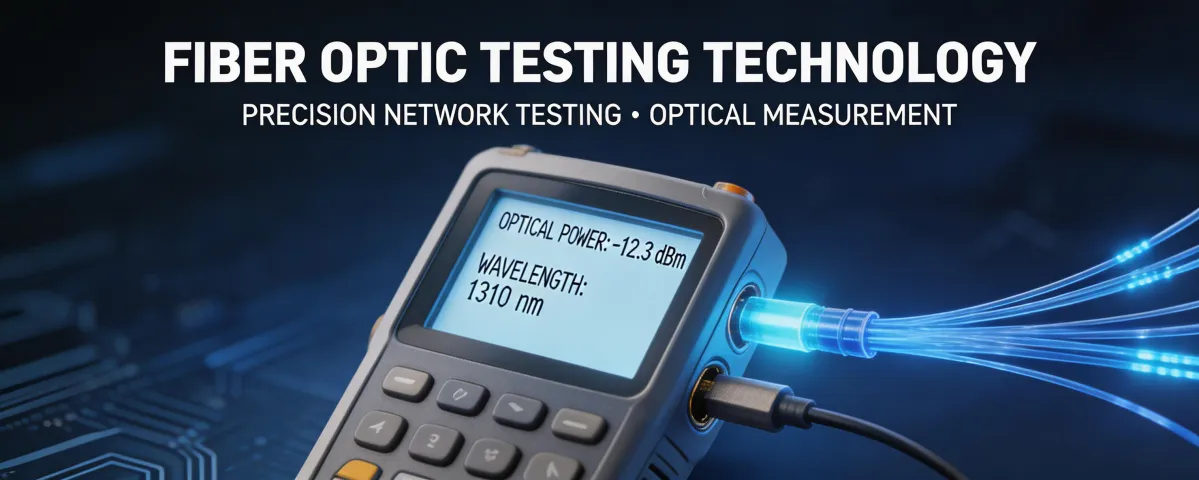
The word “multimeter” causes another layer of confusion. An optical multimeter doesn't measure voltage or resistance; it measures light. The EXFO FOT-930 is this kind of instrument. It sends a calibrated optical signal through the link and measures what arrives at the other end. So the VFL answers “where is the problem?” while the FOT-930 answers “is the link loss acceptable after I fix it?”
Why I stopped buying the cheapest VFL
I'll be honest: I made the mistake I'm warning you about. In 2023, a supplier quoted $500 for two “compatible” visual fault locators. An EXFO distributor quoted $650 for two EXFO visual fault locators with the adapter style our techs needed. I asked for a side-by-side demo first. The supplier said “no problem” (not that we ever got one).
Then the extra costs appeared: freight, a rush fee, and a restocking clause. The $500 quote became $812—$312 more than the original quote and $162 more than the EXFO quote. The supplier also advertised “certified,” but couldn't provide a calibration certificate. Per FTC advertising guidelines (ftc.gov), claims need to be truthful and substantiated. That missing certificate was a red flag, not a nitpick.
Worse, two of the units did not maintain a stable signal. A technician took one into a customer maintenance window, and the tool failed mid-test. The window closed, the job had to be rescheduled, and that labor cost was enough to buy both EXFO units and then some. The $500 quote wasn't cheap; it was the most expensive quote on the table.
A loaded field engineer costs our company roughly $75 an hour. When a tool fails during a scheduled maintenance window, you're paying for the failed visit and the return visit. That's about $600 in our case before materials—more than the price gap we were arguing about. TCO isn't a finance buzzword; it's a tool for deciding which quote to sign.
That experience changed how I compare bids. I now check:
- Delivered price, including minimum-order fees and freight
- Availability of connector adapters and accessories
- Calibration records and line-item invoicing
- Return/replacement policy for defective units
- Field failure cost—usually bigger than any price difference
Why the EXFO FOT-930 multimeter gets our budget
For one thing, an EXFO optical multimeter like the FOT-930 is a different class of tool from a visual fault locator. A VFL is great for finding a dead fiber or tracing a fiber in a patch panel, but it cannot tell you whether the repaired link meets loss requirements. The FOT-930 can. It gives the technician a number instead of a glow.
The FOT-930 also requires a little more training than a VFL, and that training is part of the total cost. Our lead techs spent one afternoon showing the crew how to use it. That time was real, but it paid back on the first night shift when a tech could confirm a splice instead of waiting for a second opinion.
So our standard kit contains both. Each field kit gets an EXFO visual fault locator for the first check. When the fiber is repaired, the technician uses the FOT-930 to verify insertion loss before closing the job. That combination has reduced repeat visits because techs no longer leave a job after making the red light visible—they measure the remaining loss too.
Is that overkill for everyone? No, because even a huge network is a collection of finite physical links. Each link has a beginning, an end, and measurable loss in the middle. That's why loss testing belongs in your kit. But yes, if your team only traces fibers and never certifies them, a standalone EXFO visual fault locator may be enough. Skip the FOT-930 until a loss test is actually on the work order.
The honest caveat
TCO doesn't mean “always buy the premium brand.” It means calculate what the equipment will actually cost over its useful life. Sometimes a basic tool wins. Last month I ordered a smaller accessory kit to save $31, and it didn't fit our new launch cable. The next-day replacement shipped for $89. That's a reminder that my own rule is not a magic formula—it's a habit.
One more thing: don't buy a VFL just because the box says EXFO. If the connector interface is wrong, the battery is unusual, or no local distributor can service it, it will be a bad fit no matter the brand. We verify that every tool in the kit matches the connectors used in the networks we maintain.
If you found this article because you just typed “what is networks” and now you're staring at a purchase order, the bottom line is: ask the techs what tests they run, get the right EXFO tools with the right connectors, and calculate the whole cost before you approve a quote. The repair you avoid is the one that pays for the difference.