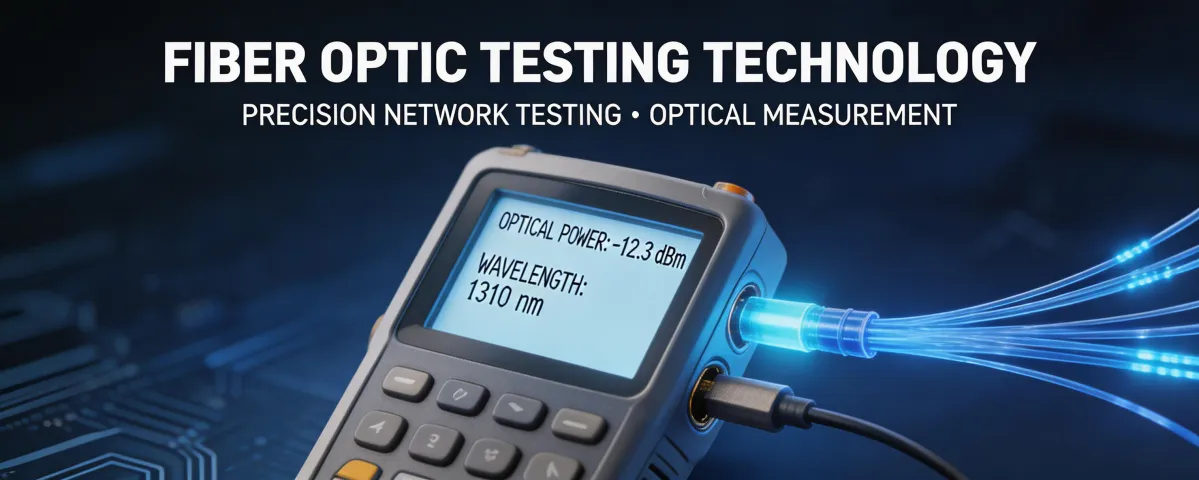
Here's the short answer: If you need an EXFO tester in the field this week and haven't spec'd one yet, get the MaxTester 715B with iOLM. It's the unit I've recommended in nearly every urgent fiber deployment since 2023. And the 'EXFO vs Crown Castle' question that keeps showing up? That's not a product comparison. You're asking the wrong question.
If you've ever had a cutover delayed because the test equipment wasn't ready, you know that feeling. I've been on the procurement side of that panic more times than I can count. In 12 years of coordinating emergency test and measurement orders, I've handled more than 200 rush requests. Trust me on this one: the tester itself is rarely the hard part. The hard part is making a decision when the deadline is already breathing down your neck.
Why I'm confident in this answer
I do not mean every project needs the same box. But for field-level PON and FTTx work, the 715B is the safest call. The reason is simple: it gives technicians the trace analysis they need without turning every job into a training session.
One example sticks with me. In March 2024, a regional fiber contractor called 36 hours before a switch cutover. Their existing tester couldn't validate an MDU riser with 16 PON splits. We sourced a 715B with iOLM, paid overnight freight, and had them running by the next afternoon. Missing that window would have triggered a $50,000 penalty clause on the construction contract. That is not a hypothetical risk. That's a real number.
The surprise wasn't the test speed. It was how much uncertainty disappeared once the technicians had a clear pass/fail answer from the iOLM. They stopped second-guessing their own traces and started moving to the next riser.
How to choose: 715B, C300, or Infinity
The 60-second version is basically three questions.
- Are you working on FTTx, PON, or enterprise fiber, and the team needs a rugged handheld OTDR? Get the MaxTester 715B. For most access-network jobs, it's a no-brainer.
- Do you need a compact, fast pass/fail tool for one specific fiber type? The EXFO C300 is worth a serious look. It's a smaller unit in the C-series, and it's easier to put in the hands of a technician who just needs a go/no-go answer. But don't buy it just because it looks newer. Match it to the actual test process.
- Do you have multiple field crews and need the results to tell one story? Add EXFO Infinity. It's not a hardware replacement. It's the software layer that collects test data, organizes it, and makes it usable for network documents and carrier deliverables.
If you're wondering whether the 715B is overkill, think about this: iOLM, or Intelligent Optical Link Mapper, is the feature that makes EXFO gear different from a basic OTDR. It shows you a visual map of the fiber link and flags each event as pass or fail. For a rush job, that matters. It removes the guesswork from trace interpretation and lets a crew make decisions in the field instead of sending traces back to an engineer.
I went back and forth between the 715B and the C300 on a small-cell rollout last year. On paper, the C300 made sense because the field crews were only testing one fiber run per location. My gut said the 715B would still be more useful when they hit a surprise on the rest of the network. We went with the 715B, and it was the right call.
That doesn't mean the C300 is wrong. It just means the choice should be based on the technician, the fiber plant, and the reporting workflow—not on which model looks more current.
What 'EXFO vs Crown Castle' Actually Means
Let's address the search term that likely brought you here. Crown Castle is not an EXFO competitor. Crown Castle is a communications infrastructure operator—towers, small cells, and fiber. EXFO makes test and service assurance tools that are used inside those networks.
So comparing EXFO and Crown Castle is not like comparing two test equipment vendors. It's closer to asking whether you should buy a ladder or a toolbox. If you're working on a Crown Castle site, they often have specific testing and reporting requirements. EXFO equipment is a way to meet those requirements—not an alternative to them.
If you're actually comparing the cost of buying your own test equipment against using Crown Castle's managed infrastructure services, that's a real make-vs-rent decision. In that case, do not base it on hardware price alone. Factor in training, support, calibration, and how many jobs the same tester will cover.
Red Flags and Fine Print
The most frustrating part of buying test equipment is not the hardware. It's the exclusions. You'd think a written quote means one price, but hidden line items live everywhere.
I've learned to ask 'what's NOT included' before 'what's the price.' On the same EXFO model, we've seen quote differences of nearly 35% for what looked like the same unit. The difference was never the unit. It was adapters, calibration certificates, firmware options, and support plans.
The vendor who lists all fees upfront—even if the total looks higher—usually costs less in the end.
That lesson cost me a contract in 2021. We assumed calibration certs were part of the quote. They weren't. Since then, my rule has been simple: ask for the full bundle in writing before you compare prices. If a reseller hesitates to list the extras, that's a red flag.
If you're buying for a carrier project, also ask whether the tester supports the report format your customer requires. The last thing you want is a certified test that the network owner cannot read. That's a deal-breaker, not a minor annoyance.
When This Answer Doesn't Apply
My experience is based on roughly 200 rush orders with North American telecom, enterprise, and utility clients. If you're purchasing for a central office lab, a hyperscale data center, or a subsea cable project, your decision tree is different. Don't take a field-tester shortcut for a lab-grade installation.
This was accurate as of January 2025. EXFO refreshes product lines and part numbers, so verify current availability with your reseller before ordering. The market changes fast, and so do module options.
Bottom Line
Bottom line: if you're under deadline, stop treating test equipment as an afterthought. For field fiber work, the 715B is the safest default. Add the C300 if your workflow really calls for a compact pass/fail unit, and use Infinity when you need field data to become network-level insight. And if someone tries to frame 'EXFO vs Crown Castle' as a head-to-head battle, walk away. You're comparing a test supplier to an infrastructure operator—not making a purchasing decision.