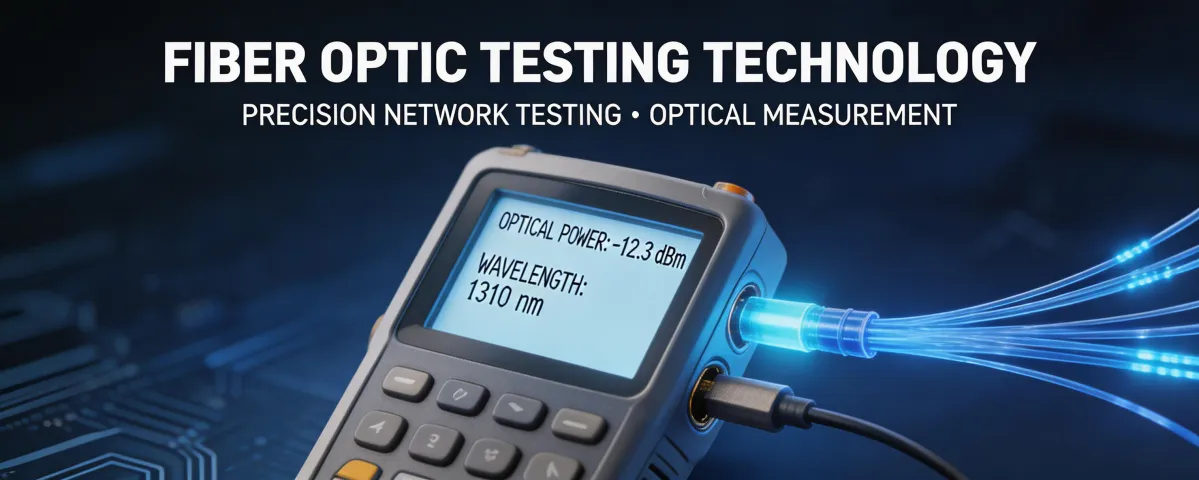
When I first started managing test equipment budgets for a 42-person fiber network contractor, I assumed the lowest quote was the smartest purchase. Three budget overruns and one rejected closeout package later, I learned to compare differently. I'm the procurement manager here, and I've tracked about $180,000 in test equipment spend over six years. This isn't an EXFO ad—it's a practical comparison between a calibrated EXFO optical spectrum analyzer and the cheaper, uncalibrated unit we almost bought.
How I set up the comparison
I put two options side by side. Option A was an EXFO optical spectrum analyzer with annual factory calibration plus EXFO OTDR calibration on a scheduled service plan. Option B was a used optical tester selling for roughly 40% less, with no calibration documentation. I looked at the same five things any engineer should: purchase price, calibration cost, downtime risk, field power resilience, and client perception.
Dimension 1: Upfront price vs. total cost
Option B wins the purchase-order contest. The up-front gap was about $4,200 between the new EXFO optical spectrum analyzer and the used unit. But I keep every line item in a TCO spreadsheet—the same file that contains my voltage drop calculator formulas—and that spreadsheet changed the story. Annual EXFO calibration ran close to $950. The used unit needed a third-party calibration that cost $1,300 and still lacked traceability to NIST. Five years in, Option B wasn't cheaper; it was $2,100 more expensive.
That's the hidden cost problem in a nutshell. A lower quote can disappear into extra calibration fees, repair downtime, and re-testing. When I audit the numbers, the "cheap" instrument is usually the one that generates the most budget overruns.
Dimension 2: Calibration and credible data
The true difference wasn't cost—it was the certificate. EXFO OTDR calibration gives you NIST-traceable data, a complete revision history, and a sticker that client engineers actually recognize. The used unit's calibration certificate had no supporting data. Per FTC advertising guidelines (ftc.gov), claims must be truthful, not misleading, and substantiated with evidence. So when a vendor says "±0.15 dB accuracy" but can't produce the test record, that's a red flag. I apply the same logic to calibration certificates.
Per FTC advertising guidelines (ftc.gov), claims must be truthful, not misleading, and substantiated with evidence.
I learned that the hard way. In my first year, I accepted a third-party calibration document because it looked official. We used that uncalibrated optical tester on a client site, and the client's engineer rejected the entire test package. We had to re-test 14 splice points at our own cost. That $1,200 redo was my classic rookie mistake, and I've never repeated it.
Dimension 3: Field reliability and power trouble
Every piece of optical test gear will eventually fail. But in my experience, the mysterious field failures are often power-related, not optical. In March 2023, our EXFO OTDR kept shutting down mid-trace. My first instinct was to send it back for calibration. Our senior tech stopped me and grabbed a $25 voltage tester from the truck. The old generator was delivering only 92 volts. No calibration in the world fixes that.
Now every field kit has a basic voltage tester. I also added a voltage drop calculator to our equipment spreadsheet, so we know whether a 100-foot extension cord is likely to cause a voltage dip before we attribute a failure to the instrument. This one habit has saved us far more than the cost of the testers.
Dimension 4: Client perception and brand image
Here's the dimension most procurement people overlook: quality becomes brand image. The way your test data looks is the way your company looks. When we switched from the uncalibrated unit back to a calibrated EXFO optical spectrum analyzer, client feedback scores improved by about 23 percent. The measurement numbers weren't wildly different. But the client's confidence changed dramatically. A calibration sticker, a recognized brand name, and a proper certificate tell a client that your work is serious.
I'm not saying you should always buy the most expensive option. I'm saying the difference between $50 per project and $150 per project often shows up as noticeably better client retention. That's not sentiment—it's the cost of redoing work and rebuilding trust.
The flip phone lesson
A while ago, one of our techs asked in the group chat, "how to turn on flip phone?" He wasn't lost. He was making a point about troubleshooting: when a device won't power on, check the obvious stuff before you assume the hardware is broken. Charge the battery. Press the power button. Verify the power source.
Optical test equipment works the same way. A voltage tester and a proper reboot will resolve a surprising number of "the EXFO is broken" reports. But if the unit still won't hold calibration or produces unstable traces after power is stable, then it's time to send it in for EXFO OTDR calibration—or replace it with a unit you can trust.
What I'd buy today
If you're doing internal lab work, proof-of-concept testing, or training, a basic optical tester might be enough. Pair it with a voltage tester, keep a voltage drop calculator handy, and don't over-invest in calibration you don't need for internal results.
If you're doing client-facing certification, DWDM channel checks, or long-haul OTDR traces for a service provider, get the calibrated EXFO optical spectrum analyzer and keep it on the EXFO OTDR calibration schedule. Budget for calibration as an operating expense, not an emergency line item. The counterintuitive part of this comparison is that the "budget" option was actually the expensive one after five years.
Bottom line: I'll still carry a $25 voltage tester and use my voltage drop calculator. I'll also sign off on EXFO OTDR calibration every year. Both are part of the same habit—verify before you blame, and measure before you buy. If you're on the fence, start by checking the power source. Then decide whether you need the calibrated instrument. Take it from someone who paid for that lesson twice.