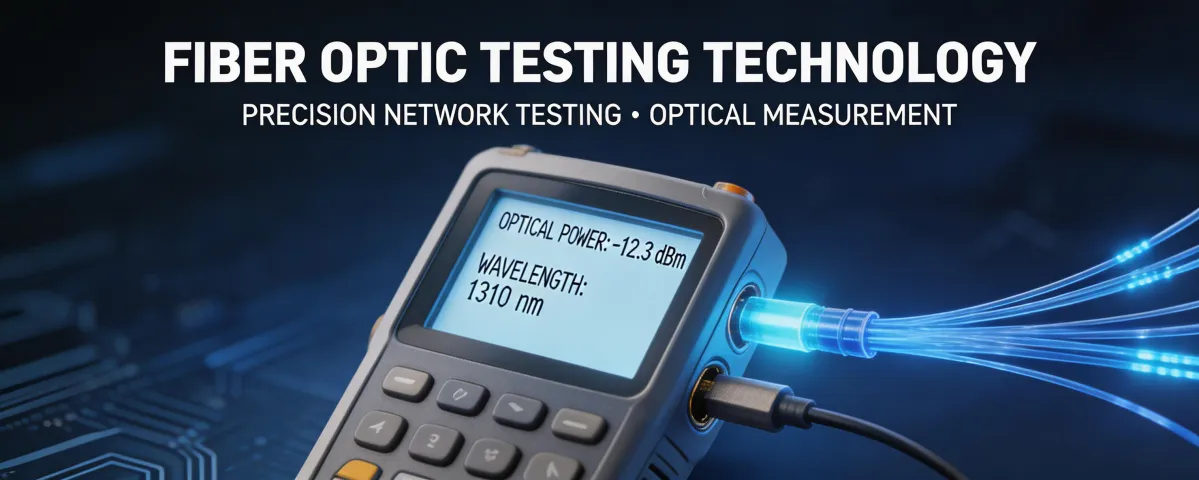
Which Tool Should Be in Your Van When the Call Comes at 4:30 PM?
In March 2024, I got a call at 4:30 PM. A hospital was migrating a critical link the next morning. The normal turnaround for a fiber test report is three days. We had hours. Two EXFO tools were sitting in the van: an EXFO MaxTester 720C and an EXFO light meter.
Which one did I grab?
Honestly, the answer depends on the emergency. And that's what this comparison is about.
I'm not a technology reviewer. In my role coordinating field test tools for a telecom contractor, I've handled 200+ rush orders in 12 years, including same-day turnarounds for hospital networks and data center providers. This is the practical side of choosing between a full EXFO MaxTester 720C and a dedicated EXFO light meter like the FPM-3210.
The Comparison Framework
Let's be clear about what these two boxes are. The EXFO MaxTester 720C is a full OLTS (optical loss test set). It can run loss and return-loss tests, compare results to a limit, and produce a pass/fail verdict on a fiber link. The FPM-3210 is a power meter. It measures optical power. That's basically it.
So the comparison is not “which is better.” It's “which is better for the job you do most.” I'll judge them on three dimensions: measurement depth, speed in an emergency, and cost fit.
When I compared the MaxTester 720C and the FPM-3210 side by side on the same fiber run, I finally understood why the details matter. The bigger tool answers questions you didn't know you had. The smaller tool answers the one question right in front of you.
Dimension 1: Measurement Depth
The MaxTester 720C is the kind of tool you buy when you need proof. It performs an end-to-end loss test on a single-mode link, using a built-in light source and power meter. It can measure return loss, which is critical for PON networks. It also stores results, so you can walk away with a report instead of a sticky note.
A bare EXFO light meter, like the FPM-3210, just measures light. Plug in a patch cord, hit a button, and you have a number. If you pair it with a light source, you can manually calculate insertion loss. But that's where it ends.
I'm not an optical engineer, so I can't speak to every spec on the datasheet. What I can tell you from a field-coordination perspective is this: if you're doing a handover acceptance test, the light meter is not enough. The MaxTester 720C is the right answer. If you're chasing “is this jack dead?” the light meter is enough.
Actually, the light meter is better. Not ideal, but better for that job. You don't carry a chainsaw to trim a bonsai.
Dimension 2: Speed in an Emergency
Here's the part that surprised me. In a true crunch, the simpler tool can be faster.
Why does that matter? Because when a client says a fiber wall jack in Room 402 is dead, you don't need a certification. You need to know if light is present. A light meter does that in seconds. No reference, no test file, no training menu. The MaxTester can also do a power check, but it's a bigger instrument with more buttons. If the tech is stressed and in a hurry, that extra capability becomes extra friction.
That said, you need the MaxTester for the opposite emergency. In 2024, a client spinning up a vSRX instance kept losing data-plane traffic. Everyone blamed the virtual network. The actual problem was the fiber path from the server rack to the core. Once we suspected fiber, we needed an end-to-end loss measurement, not just a power reading. The MaxTester found a bad splice in minutes.
So the honest answer: if the emergency is “is there light in this jack?” use the FPM-3210. If the emergency is “is this 300-meter link good enough to carry production traffic?” use the MaxTester 720C.
Had 20 minutes to decide in the hospital case. Normally I'd spend an hour digging into test procedures. There was no time. I went with the MaxTester, because the hospital needed a documented link test, and I knew the technician could run it blind. That call worked out. The next call came in at 9 PM, and I had to send another tech back to the shop for a simple power check.
Dimension 3: The EXFO MaxTester 720C Price vs. a Light Meter Budget
Let's talk about the EXFO MaxTester 720C price. I don't have a current price sheet in front of me, and quoting exact numbers from memory would be foolish. But I can tell you this: the gap is large. The MaxTester is a serious investment. A dedicated EXFO light meter is a much smaller line item.
That means the question isn't just “which one is more capable?” It's “which one will actually get used?” A team of five techs can each carry a light meter in their bag. They won't each carry a MaxTester.
For a fiber vendor doing installations and turn-up contracts, the MaxTester pays for itself quickly. For an enterprise IT team that mostly needs to verify patch cords and wall jacks, the light meter is the daily driver, and a MaxTester might be overkill. Or a rental.
Don't underestimate the cost of care and calibration, either. Test instruments need annual calibration to be trustworthy. A fleet of MaxTesters costs more to maintain than a fleet of simple light meters. Again, the bigger tool is not “better” in every budget.
For insertion-loss testing, industry standards like TIA-526-7 assume a stable light source and a calibrated power meter. A dedicated light meter can handle that. Return loss and bidirectional testing are where the OLTS-class tool like the MaxTester 720C earns its keep.
Which One Should You Buy?
Here's my honest, scenario-based answer.
Choose the EXFO light meter if:
- You mostly do break/fix calls and first-response troubleshooting.
- Your techs need to check power quickly at a wall jack, patch panel, or a temporary connector.
- The EXFO MaxTester 720C price would mean your team compromises on coverage, like one good tool sitting in a locked case.
Choose the EXFO MaxTester 720C if:
- You do fiber turn-up, PON deployments, or acceptance testing.
- You need documented test results for clients or compliance.
- You want one box that can do loss, return loss, and light power without carrying a source and meter separately.
There's no universal winner. But there is a bad choice: buying the wrong tool for the emergencies you actually face. A vendor who tells you “this one is right for everything” isn't doing you a favor. I'd rather work with a specialist that knows the boundary.
If you're still torn, buy the light meter first. It handles the most common call. Rent the MaxTester for the week you need a full certification. You'll know after a few jobs which one belongs on your truck.
Trust me on this one. The right tool in an emergency is the one you're not afraid to grab quickly.