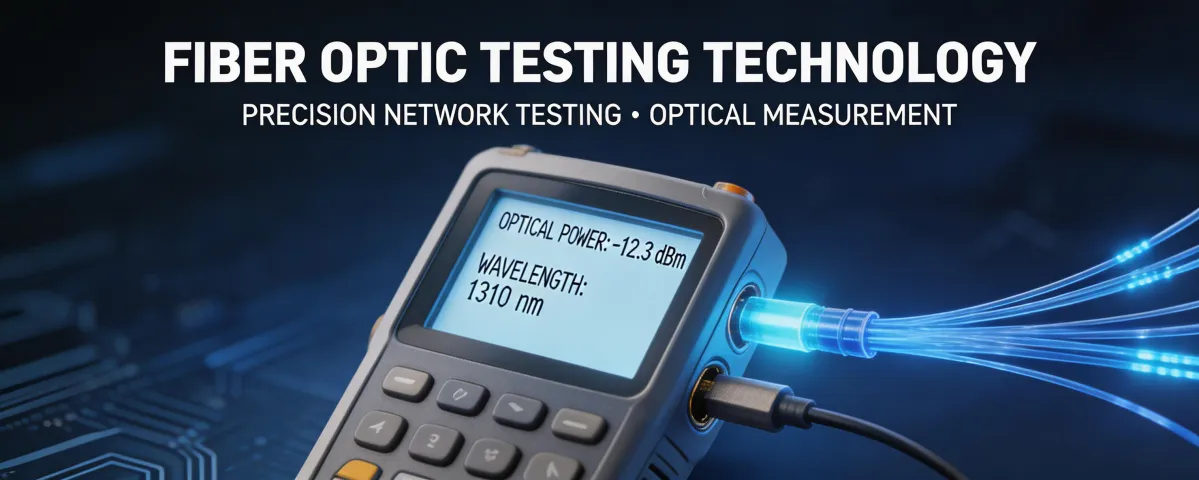
I manage procurement for a mid-sized telecom contractor. Our annual budget for network testing gear sits around $180,000. Every quarter, I'm comparing quotes, tracking total cost of ownership (TCO), and trying to avoid the kind of hidden fees that can blow a quarterly plan.
So when the engineering team came to me debating EXFO Maxtester 715B vs. standard Cisco switches for field testing, I knew I had to look past the sticker price. This isn't a battle of 'which is better' in a vacuum. It’s a question of which tool fits the job description and the budget. I've spent the last six years tracking every invoice in our system, and I've seen both shine and fail spectacularly.
Let’s break down the real cost and utility differences based on what I’ve actually seen on paper and in the field.
The Core Difference: Purpose-Built vs. General-Purpose
This is the first thing I hammer out in any comparison. The EXFO Maxtester 715B is a purpose-built tool for optical network testing. It’s a specialist. A Cisco switch is a generalist workhorse designed for data transport, not diagnostics.
I remember our first year in business. We bought a handful of used Catalyst switches thinking they could double as testers. They passed traffic. They did not test the integrity of the fiber. We learned that lesson when a $4,200 installation failed because we couldn’t verify the link budget. That redo cost us time and reputation. Simple.
Dimension 1: Testing Capability (The No-Brainer)
The EXFO unit is designed for Tier 1 to Tier 3 testing. It measures optical power, loss, and can run OTDR traces. A standard switch can show you link status (green or red), but it gives you zero insight into signal quality.
“The switch told me the link was up. The EXFO told me the link was operating at a 3dB loss. The difference? A callback at 2 AM a month later.” — A field tech’s report in our log.
If your job is just to check connectivity in a data center, a switch is fine. If you’re certifying a new fiber run for a client, you need the Maxtester. There’s no gray area here. Trying to use a Cisco switch for fiber testing is like using a hammer to drive a screw – you might make it work, but it’s the wrong tool.
Dimension 2: Total Cost of Ownership (TCO)
Here’s where my spreadsheet gets a workout. Let’s be specific.
The EXFO Maxtester 715B:
- Initial Cost: Roughly $4,000 - $6,000 for a used or basic model. New units with all modules can hit $15,000+. This was accurate as of Q4 2024. The market changes fast, so verify current rates before budgeting.
- Hidden Costs: Calibration (annual), repair costs if a fiber connector gets dirty or damaged, and specific training for field crews.
- Lifespan: 5-7 years if properly maintained. We have a unit from 2019 that still runs fine.
The Standard Cisco Switch (e.g., Catalyst 9200):
- Initial Cost: $2,000 - $4,000 for a basic 24-port PoE model.
- Hidden Costs: We once had a Cisco licensing audit that required us to buy a new support contract. That was a $1,200 surprise I didn't see coming. Also, deploying a switch into a testing rack adds power overhead and rack space.
- Lifespan: 8-10 years for data transport, but at the 5-year mark, most need a software upgrade or hardware refresh to stay secure.
The Surprising Conclusion? For pure testing, the Maxtester wins on cost if you calculate cost per tested parameter. For a general-purpose tool that also checks basic connectivity, a switch is cheaper. But that's like saying a bicycle is cheaper than a truck. It is, until you need to haul gravel.
Dimension 3: Simplicity & The 'Rookie Mistake' Factor
In my first year, I made the classic specification error: I assumed 'standard' meant the same thing to every vendor. I bought a cheap switch for testing, thinking it was enough. It wasn't. The field team spent more time interpreting vague link status LEDs than actually diagnosing problems.
The Maxtester has a dedicated 'Pass/Fail' display. It’s clear. It tells you the result without a 30-minute lesson in network protocols. I’ve seen new hires pick it up in 10 minutes. I’ve also seen them take two hours to configure a basic test on a switch CLI. Time is money. That time spent learning a complex tool is a cost that doesn’t appear on any invoice.
“The EXFO is a 'no-brainer' for field techs. The switch is a 'no-where' for field techs.” — A line manager after the first deployment.
So, What Do You Buy?
Here’s my practical advice after tracking all these numbers. It’s not a blanket recommendation. It depends on your team.
Buy the EXFO Maxtester 715B IF:
- You are installing or maintaining fiber networks (PON, OTN, FTTH).
- Your crew needs to certify links with documented test results.
- You can afford the upfront cost of a specialized tool.
- Your field team is more hands-on and less network-cli-focused.
Buy a Standard Cisco Switch IF:
- You primarily need to prove basic copper connectivity (Ethernet).
- You already have advanced optical testing gear for the critical jobs.
- You are on a very tight budget and can't justify a dedicated tester.
- Your team is made of network engineers who can extract useful diagnostic data from the switch’s interface.
Bottom line: For the cost of one bad installation redo, you could buy a quality Maxtester. I’d rather spend $4,000 on the right tool than $4,200 on a redo. That’s a 5% difference in favor of the tool. For the work we do, the EXFO is a non-negotiable investment. The switch is a desk ornament.
I learned this in 2020. Things may have evolved since then, especially with new software-defined networking options. But the physics of fiber hasn't changed.