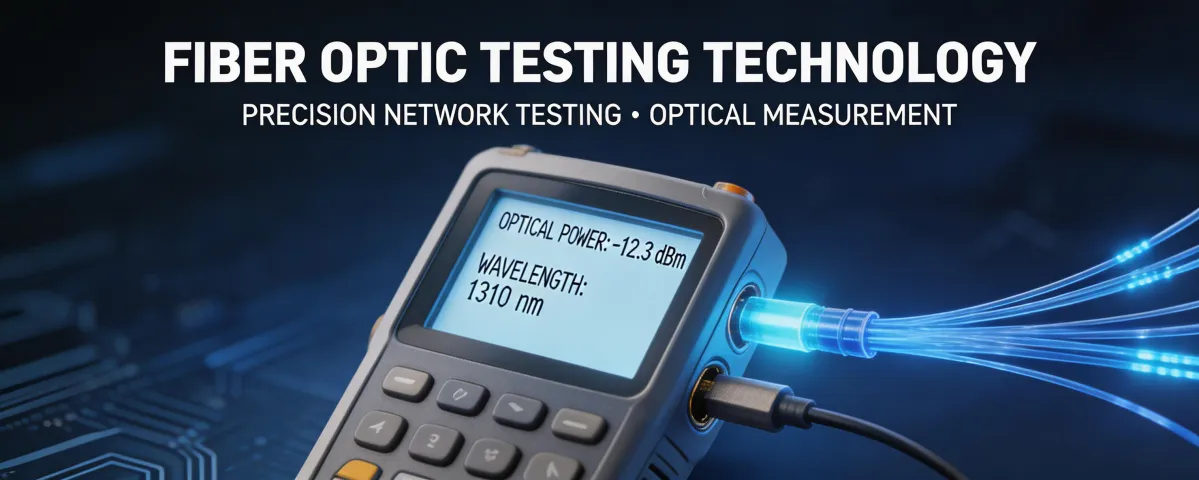
If you're trying to choose between an EXFO FTB1 and a Klein multimeter, stop. These are not replacements for each other. I'm going to show you why, and where you actually need each one.
I'm a field test coordinator at a telecom services company. I've spent the last six years on emergency fiber turn-ups, dark-fiber restorations, and deadline-driven network upgrades. In my role, I don't ask which brand is better. I ask: what's the deadline, and what layer of the network is actually broken?
A lot of search traffic on this topic looks like the same question: EXFO FTB1 vs Klein multimeter? Which one wins? I understand why it gets asked. From the outside, both are handheld electronic testers with screens, buttons, and high price tags. But that's where the similarity ends. The Klein multimeter measures electricity. The EXFO FTB1 measures light. Choosing between them is like choosing between a thermometer and a pressure gauge because they're both gauges.
What Each Tool Actually Does
Here's the honest version, based on tools I keep in my own truck:
- Klein multimeter - Use it for AC/DC voltage, continuity, grounding, and power checks at the demarc. It's the first tool I grab when an optical network terminal is rebooting or a remote site has no power.
- Clear phone / C300 test set - Use it to verify a voice path. The C300 is basically a commercial-grade clear phone that tells you if dial tone, ring voltage, and line polarity are alive. It has saved me from blaming fiber for PBX problems.
- EXFO FTB1 - Use it for optical loss testing and OTDR trace work. It's the tool I reach for when I need to certify a splice, find a fault on a dark fiber, or prove that a path is ready for handoff.
- EXFO 930 - Use it when the job goes beyond basic loss and power. If you're validating wavelength-level details on a WDM or spectrum troubleshooting job, the EXFO 930 (or an equivalent module) answers questions the other tools can't touch.
Seeing those tools side by side made me realize the comparison was never real. The multimeter does not fail as a fiber tester; it simply isn't one. And the FTB1 is not an overpriced multimeter; it's an optical instrument with a completely different job.
I Learned This by Skipping It
I only believe this because I ignored it once. In March 2024, my crew had 36 hours to certify a dark-fiber path for a hospital. The customer's IT director was standing outside the network room, and the construction schedule was already slipping. We checked the powered equipment with a Klein multimeter, ran a light source and power meter test, and the numbers looked acceptable. The OTDR module was in the trailer. I decided to skip the trace because the deadline was too tight. That was my mistake, not the equipment's.
The link went down the next night. When we went back, the OTDR showed a loss event at a splice that had been stressed in its tray. The fiber had passed the overall loss test, but the trace would have shown the problem at the splice before we closed up the case. We spent the rest of the night fixing something we could have caught in the first hour. Comparing that failed turn-up to the next job—same rushing, same type of customer, but with a real FTB1 trace before handoff—made me realize I hadn't saved time. I had moved the problem to 2 a.m.
Voice circuits taught me the same lesson in reverse. On another emergency call, a customer said a legacy line had no dial tone. The ticket said possible fiber issue. Before unpacking the EXFO cases, I plugged a C300 test set into the network interface and heard dial tone instantly. The problem was inside the customer's phone system, not on the fiber. That was one of those moments where a ten-second check with a clear phone saved a full fiber troubleshooting roll.
The Honest Limitation
Now for the part that sounds less exciting: I don't think every tech needs both tools. If your week is mostly electrical work—checking power supplies, verifying grounds, tracing circuits—a Klein multimeter is enough, and an EXFO FTB1 would be wasted money. Add a C300 or another clear phone if you also touch analog voice lines. Add the EXFO FTB1 only when optical acceptance and troubleshooting are part of your responsibility. Add EXFO 930-level capability only if you handle dense wavelength networks and need to know what's happening on each channel.
That's the honest limitation. I'm not going to pretend the expensive fiber tester is always the answer. It's the answer for a specific question, and if you're not asking that question, don't buy it.
So, Who Wins?
The EXFO FTB1 vs Klein multimeter comparison doesn't have a winner, because it was never a fair match. The multimeter wins when the problem is electrical. The EXFO FTB1 wins when the problem is optical. And a clear phone or C300 wins when the problem is a voice circuit that only looks like a data problem.
Use the tool that matches the signal you're responsible for. That's not a compromise. It's how you keep a 36-hour turnaround from becoming a 2 a.m. rework.