Why This Comparison Matters for Your Budget
Let's get straight to it. If you're managing a telecom or network ops budget, you've probably had the same debate I have: "Can we get away with using a standard multimeter for this fiber job, or do we need a dedicated optical tester like the EXFO FPM-300?"
I'm a procurement manager for a mid-sized fiber installation company. Over the past 5 years, I've tracked every dollar spent on test equipment and connectors across 200+ projects. I've seen the cheap option bite us, and I've seen the premium tool pay for itself. This isn't a theory piece—it's a breakdown of the hard costs I've seen.
We're comparing two broad approaches in this article:
- Option A: The Generic Multimeter — A general-purpose electrical tester used to measure voltage, current, and resistance. Some techs try to use these to check continuity on a fiber link, mostly because it's what they have on the truck.
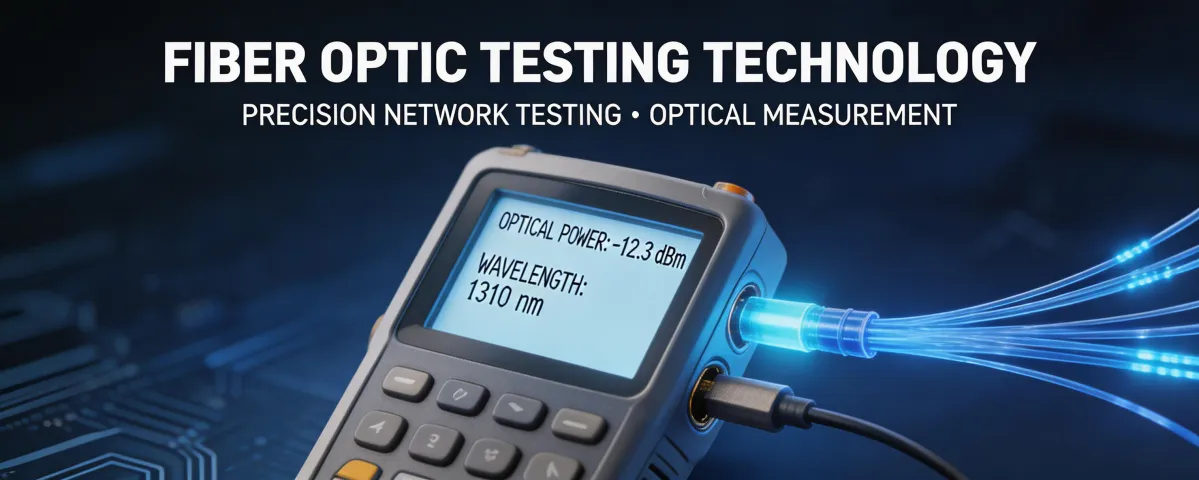
- Option B: The EXFO FPM-300 Light Meter — A dedicated optical power meter designed specifically for measuring light levels in fiber networks. It's built for the job, but it costs more upfront.
We're going to compare them on three dimensions: upfront cost vs. total cost of ownership, operational efficiency, and accuracy & consequences of failure. The goal is to give you a framework to decide, not just declare a winner.
Dimension 1: Upfront Cost vs. Total Cost of Ownership (TCO)
This is where the money talk starts. You can buy a decent multimeter for $50-200. An EXFO FPM-300 light meter (like the FPM-300 series), complete with a calibrated optical head and connectors, will run you somewhere between $800 and $1,500 depending on the package.
The first reaction is obvious: "The multimeter is way cheaper." But I've learned (the hard way) that the purchase price is just the beginning.
The hidden costs of the generic multimeter approach:
- Incompatibility with connectors: A multimeter doesn't have a standardized optical connector interface. You'll need an adapter or a pigtail, which adds $20-50 per job. I've seen teams buy multiple adapters because they didn't plan for different connector types (SC, LC, etc.).
- No calibration for optical power: A multimeter measures electrical voltage. To measure optical power, you need a photodiode and proper calibration. Without it, your readings are basically guesswork (ugh).
- Potential for network damage: Using a high-voltage multimeter on a sensitive optical receiver can cause damage. The repair cost for a single SFP or optical line card? Easily $300-2,000. That's a ton of money.
The hidden savings of the EXFO FPM-300:
- Built-in optical head: It comes with a calibrated InGaAs detector and a universal connector interface (like the 2.5mm or 1.25mm universal adapter). No extra parts needed.
- Auto-wavelength detection: The FPM-300 automatically senses the test wavelength (850nm, 1300nm, 1310nm, 1550nm). No manual guessing, no errors.
- Accurate power measurement in dBm: You get real optical power readings, not voltage. This is the data your certifier needs.
The cost math from my experience:
Let me give you a real example. In Q2 2023, I compared costs across 5 vendors for a set of entry-level fiber test kits. Vendor A quoted a generic multimeter with an optical adapter for $250. Vendor B quoted an EXFO FPM-300 for $1,100. I almost went with Vendor A until I calculated TCO for a 12-month period covering 100 jobs:
- Option A (Multimeter): $250 + $1,200 in adapter costs (different connectors) + $450 in repair costs (two SFPs fried) = $1,900 total
- Option B (EXFO FPM-300): $1,100 + $0 in adapters + $0 in damage = $1,100 total
Bottom line: The "cheap" option cost us $800 more in its first year. That's a 72% premium over the dedicated tester. To be fair, the multimeter still works for basic electrical tasks, but for fiber testing, it was a penny-wise, pound-foolish choice.
Dimension 2: Operational Efficiency (Time is Money)
Efficiency is competitiveness. This is a core belief I hold after years of watching projects slip deadlines.
Using a generic multimeter for fiber testing is painfully slow. You have to:
- Find the right adapter and connect it.
- Set the multimeter to the correct voltage range (if you're trying to infer power).
- Interpret the voltage reading and convert it to dBm using a lookup table (which you probably don't have).
- Repeat for each wavelength.
The EXFO FPM-300 cuts this down drastically:
- Plug in the fiber connector (it auto-detects the type).
- Press the power button.
- Read the dBm value directly.
- Press the wavelength button to switch to 1550nm and re-read (or use auto-wavelength mode).
I timed this difference on a recent 48-fiber trunk test. With the multimeter setup (including adapter swaps), it took about 4 minutes per fiber. With the EXFO FPM-300, it took about 1 minute per fiber. For 48 fibers, that's a difference of 192 minutes (3.2 hours) vs. 48 minutes. The labor cost for a senior tech is roughly $50/hour. So the efficiency gain saved us: (3.2 - 0.8) hours × $50 = $120 on that single job.
Now, that might not sound huge. But we do 200 jobs a year. That's $24,000 in annual labor savings (seriously). The EXFO FPM-300 paid for itself in about 5 jobs. After that, it's pure profit. The automated process eliminated the adapter-hunting and conversion errors. Efficiency isn't just a buzzword; it's a line item on your P&L.
Dimension 3: Accuracy and the Cost of Failure
We're dealing with light (pun intended) here. The difference between a good splice and a bad splice can be a few tenths of a dB. A multimeter cannot measure that accurately. Its resolution is typically 0.1 mV, which translates to about ±0.5 dB accuracy at best (if you're using a calibrated photodiode). The EXFO FPM-300 has an accuracy of ±0.25 dB at 23°C.
This is where the real cost hits. An inaccurate reading can lead to a false pass—you think the link is good, but it's actually marginal. Six months later, the link fails. Now you're doing a truck roll, a re-test, and possibly a re-splice. Cost of a single truck roll and repair: $500-1,200. A false pass from a multimeter reading might affect 2% of your links. For a 100-link project, that's 2 failures, costing $1,000-2,400 in rework. The EXFO FPM-300 reduces that risk significantly.
I've also seen the opposite: a false fail. A tech uses a multimeter, gets a bad reading, cuts out a good splice, and re-dos it. That's lost time, lost material (connectors and fiber), and lost productivity. The EXFO's accuracy eliminates these wild guesses. It's a game-changer for quality assurance.
Which One Should You Pick? A Scenario Guide
So, here's my pragmatic takeaway. This isn't about one being universally better. It's about what you value.
Choose the Generic Multimeter if:
- You are strictly doing electrical continuity checks on copper cabling (not fiber).
- You need a tool for basic troubleshooting on old, copper-based networks.
- Your budget this quarter is strictly $100 and you cannot do a phased buy.
Choose the EXFO FPM-300 (or similar dedicated light meter) if:
- You are installing, maintaining, or certifying fiber optic networks (FTTH, data centers, long-haul).
- You value accuracy to prevent costly false passes and truck rolls.
- You want to reduce testing time by 3-4x and save on labor costs.
- You need to prove compliance with standards like TIA/EIA-526-7 (Standard Test Procedure for Fiber Optic System Attenuation Measurements).
My personal recommendation as a budget manager: If even 20% of your work involves fiber, buy the EXFO FPM-300. The risk of getting it wrong with a generic tester is just too high. The TCO calculation nearly always favors the dedicated tool. Plus, the look of confidence on a client's face when you pull out a proper optical tester instead of a rusty multimeter? That's priceless (but it also helps with contract renewals).
In my five years of tracking invoices, I've categorized the EXFO FPM-300 as a 'cost avoidance' item, not an expense. It saves us from the hidden costs of cheap alternatives. That's a kind of profit you can't get from a bargain bin.