The Two Toolboxes on My Expense Report
I'm an office administrator for a 40-person telecom services company. I manage all our field equipment ordering—roughly $120,000 annually across about 15 vendors. When I took over purchasing in 2020, one of the first fights I had with our senior tech was about test equipment. He wanted an EXFO FTB-1 for a new fiber project. I asked, "Can't you just use the multimeter we already have?"
That question got me a 20-minute lecture. And honestly, it was a fair one. Here's what I've learned after processing about 200 orders for network test gear: thinking these two tools are interchangeable is like thinking a wrench and a screwdriver are the same because they're both metal.
This comparison is for other admins or small business owners trying to figure out where to spend limited budget. We're going to look at three things: what they actually test, how much they cost to own (not just buy), and when you truly need one vs. the other.
Dimension 1: What They Actually Measure
This is where the biggest gap is, and where most confusion starts.
The General Multimeter (DMM)
A standard multimeter—even a good one like a Fluke 117—measures voltage (AC/DC), current, and resistance. It's your go-to for checking if a power supply is dead, if a cable has a short, or if a circuit is live. I've bought about 30 of these over the years for various teams. They cost us between $150 and $400 each, depending on features.
For copper-based networks (Ethernet, phone lines), a multimeter is useful for basic continuity checks. But for fiber optics? It's useless. A multimeter sends an electrical current; fiber uses light. You can't test light transmission with a voltage meter.
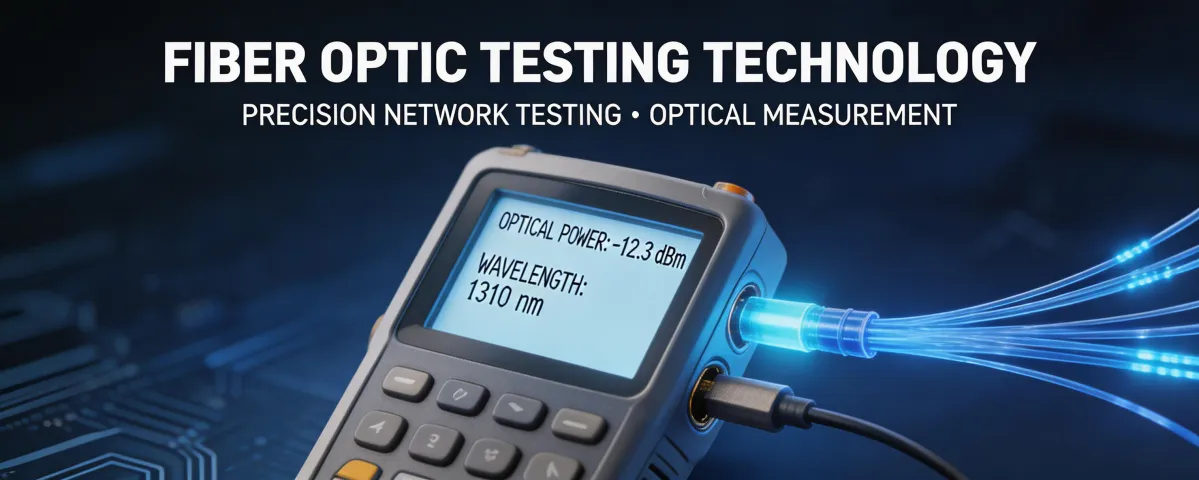
The EXFO Fiber Tester (e.g., FTB-1 with OTDR module)
An Optical Time-Domain Reflectometer (OTDR), like the EXFO FTB-1 or the newer MaxTester series, sends pulses of laser light down a fiber and measures the reflected light. It can tell you:
- Exactly how long the fiber run is (down to the meter)
- Where there's a break, bend, or splice loss
- The overall signal loss (attenuation) across the link
These devices start around $3,000 for a basic model and go up to $15,000+ for high-end units with multiple wavelengths and advanced analysis. According to EXFO's product specs (exfo.com), a unit like the FTB-1 can measure distances with an accuracy of about ±1 meter over a 100 km link.
The bottom line: A multimeter tells you if copper works. An EXFO tester tells you if fiber works and exactly where it doesn't. They measure fundamentally different things.
Dimension 2: Total Cost of Ownership (TCO)
This is the dimension where my gut said "buy the cheaper tool," but the data said otherwise after a few years.
Let's break down the real costs I've tracked in our system.
General Multimeter: Low entry, low maintenance
- Initial cost: $200 - $400
- Calibration (annual): $80 - $150, but many shops skip it for field use
- Replacement rate: About every 3-4 years, mostly from drops on concrete
- 5-year cost: Roughly $400 - $700, assuming one replacement and minimal calibration
EXFO Fiber Tester: High entry, but durable
- Initial cost (FTB-1 basic): $3,000 - $5,000
- Calibration (annual): $300 - $600, required to maintain accuracy for certification work
- Replacement rate: Every 5-7 years. These are rugged—our EXFO units have survived rain, drops from ladders, and being left in a hot truck. One fell off a tailgate and still worked. (Should mention: we had a padded case.)
- 5-year cost: Roughly $4,500 - $8,000, including calibration
On paper, the EXFO is 10x more expensive. But here's the catch: if you have fiber to test, you can't test it with a multimeter. So the comparison isn't really "buy A instead of B." It's "do you need to test fiber or not?" If you do, the EXFO pays for itself in one or two fiber certification jobs. I saw this when we bid on a building campus job that required OTDR traces for every run. Without the EXFO, we'd have subcontracted it at $500 per run. We did 40 runs. The unit paid for itself on that one job.
The bottom line: For copper-only work, a multimeter is sufficient. For any fiber work, the EXFO is an investment that quickly becomes profitable if you use it more than a few times a year.
Dimension 3: When One Can (Sort Of) Replace the Other
This is the part where I got the surprise. There are a few niche overlaps.
Some high-end multimeters have a built-in visual fault locator (VFL). It's basically a bright red laser that you can shine into a fiber. If there's a bad break or sharp bend, you might see light bleeding through the jacket. This isn't standard, but you can find it on meters like the Fluke 1587 FC (about $700).
But here's the problem: a VFL only works for breaks within about 1-2 km and can't tell you the distance to the fault. An EXFO OTDR can find a break at 80 km and tell you it's at 42.3 km. That's not a "sort of" difference—that's a completely different capability.
Per industry standards (TIA/EIA-568), certification of fiber cabling requires an OTDR trace and a power meter/loss test set. A VFL alone doesn't meet those standards. So if you need certification, the EXFO (or similar) is mandatory.
The surprising conclusion: If all you need is to check if a very short patch cable has a visible break, a VFL on a nice multimeter might save you from buying an OTDR. But for any serious work, the EXFO is the right tool. My experience is based on about 40 fiber projects across structured cabling and FTTH. If you're working with long-haul DWDM networks, your requirement for precision is even higher.
So… Which Should You Buy?
If you're a small team with a tight budget, here's my advice based on years of managing our procurement.
Buy the multimeter first if:
- Your work is 90%+ copper-based (Ethernet, phone, coax)
- You need basic electrical safety testing
- Your fiber work is limited to simple patch cord checks at short distances
- Budget is under $500 total for test gear
Invest in the EXFO (or upgrade) if:
- You're doing greenfield fiber installs
- You need to certify fiber runs per industry standards
- You're troubleshooting long-distance fiber faults
- You've got at least a $3,000 equipment budget for test gear
Most small telecom teams I've bought for end up with both. A $300 multimeter for daily electrical checks and a $4,000 EXFO for fiber jobs. When I started, I tried to make one tool do everything. It didn't work. Now I know: different signals, different tools, different budgets. And our guys in De Soto, KS, rarely complain about equipment anymore—they just ask me to reorder the cleaning supplies.