Last month, I processed Requisition 2780 for a platinum blood pressure monitor for HR. That one was easy. The harder order was next to it: a request for test equipment that included an EXFO 945 and a digital multimeter. I don't run fiber tests myself. I'm the office administrator who approves the purchase, schedules the delivery, and answers for it when accounting asks why we spent the money. If you buy tools you'll never operate, this comparison is for you.
A quick limitation before I start: I manage purchasing for a 28-person fiber-optic contractor. My experience is based on roughly 200 equipment orders over four years. If you're buying for an optical lab, a data center, or an electrical contractor, your field conditions will differ. Use this as a framework, not a technical spec sheet.
The only comparison framework I need
When an engineer requests a tester, I don't try to match decibels or channels. I ask three questions:
- What does it measure, and why does the customer care?
- Does the tool create a record that holds up when the job is done?
- What happens if the tool gives the wrong answer?
Those three questions separate the EXFO 945 from a basic multimeter faster than any spec sheet.
1. What the EXFO 945 and the multimeter measure
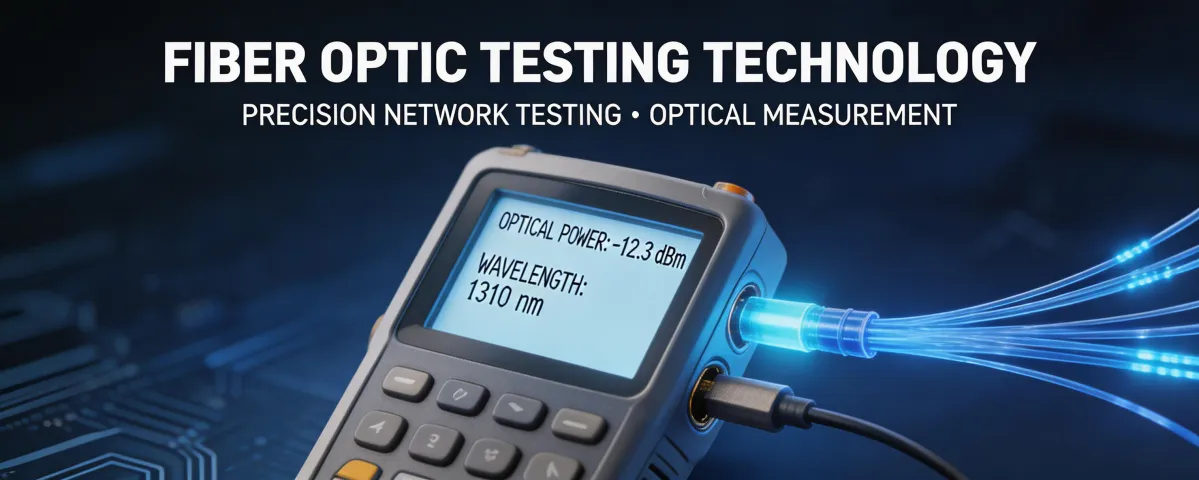
In our field workflow, the EXFO 945 is the tester used for link acceptance. When the crew has installed or activated a fiber run, the 945 checks the link and produces a result that tells us whether it meets the contract requirement. The value is not just the pass/fail reading; it's that the reading is recorded in a way that can be presented to the customer.
A multimeter measures electrical voltage, current, and resistance. It answers a different question: Is power present, and is it around the expected value? It is an everyday tool for checking power supplies, wall outlets, grounding, and continuity. The result is usually a number the tech reads on the screen.
Conclusion for this dimension: They are not substitutes. A multimeter is the budget tool that happened to share the word 'meter.' It cannot validate a fiber link, and the EXFO 945 is not the right tool for checking a 120-volt outlet.
2. What counts as proof
This was the counterintuitive part for me. A 90-dollar multimeter can show the correct voltage on the first try. That is enough for a quick repair. But a fiber acceptance project often does not end when the measurement looks good. It ends when the customer or carrier accepts the report. The EXFO 945 earns its place in the budget because it turns a field measurement into documentation: time-stamped, repeatable, and formatted for the network owner.
A multimeter can also give you proof if you take a photo of the screen. That is a lot less convincing than a generated test report. I learned that when a vendor's report format was rejected and a technician had to return to the site. The return trip cost far more than the tester would have cost if I had approved it earlier.
3. What a mistake costs
If you choose the wrong item on a PO for a ladder or a cable order, the cost is small. Test equipment is different. A wrong multimeter reading can send a tech chasing a power problem that doesn't exist. But an incomplete or rejected fiber acceptance can stop a project handoff. The 945 is the tool that prevents the expensive failure.
The counterintuitive part: the multimeter probably gets used more often in our office. It checks power supplies, outlet wiring, and simple DC circuits. The EXFO 945 is used less often, but when it is needed, there is no acceptable substitute. So I stopped comparing them on price per use.
If a vendor tells you a device is 'fully calibrated,' I apply the same standard I use for any marketing claim. Per FTC guidance, claims should be substantiated. In procurement terms, that means the calibration certificate and the test data come with the invoice. The words alone are not enough.
How to use a multimeter to test voltage (for admin confidence)
The most common question I hear around our shop from new technicians is not about fiber. It's 'how do I use a multimeter to test voltage?' If you're buying the multimeter, here is the basic version I check for in training materials:
- Put the black lead in the COM port and the red lead in the V port.
- For a wall outlet, select AC voltage mode. On most meters, that's the V with a wavy line over it.
- Touch the probes to the two live slots or terminals. A standard North American outlet should read around 110 to 125 volts. In many other countries, expect 220 to 240 volts.
- For a battery or DC power supply, select the V with a straight line and dashed line above it. Touch red to positive and black to negative. If the reading shows a minus sign, the leads are reversed; that's not dangerous, just swap them.
- Never change the dial while the probes are connected to a live circuit.
That is a practical explanation, not a safety course. If the meter's safety category and test leads aren't rated for the circuit you're working on, stop and ask someone with electrical training.
So which one belongs on your purchase order?
Choose the EXFO 945 if your team delivers fiber or network services where the customer expects a documented test result. It is not just an expensive multimeter. It's the instrument that supports your acceptance invoice.
Choose a multimeter if your team spends more time on electrical troubleshooting and power verification. You don't need a fiber tester to prove an outlet is live. A well-made multimeter with a CAT III rating and decent leads is enough.
If you buy for a field crew, the honest answer is usually both. The field kits I approve now include a 945 for fiber link acceptance and a basic multimeter for every vehicle kit. One order prevents the large failure; the other handles the thousand small checks that keep the day moving.
And the platinum blood pressure monitor? That was Requisition 2780. It required less engineering judgment than any tester PO I've processed. The vendor had a clear warranty, clean invoicing, and an instruction manual HR could follow. That, too, is part of a comparison framework: choose a supplier who documents what you buy, so you're not left explaining gaps to finance or operations later.