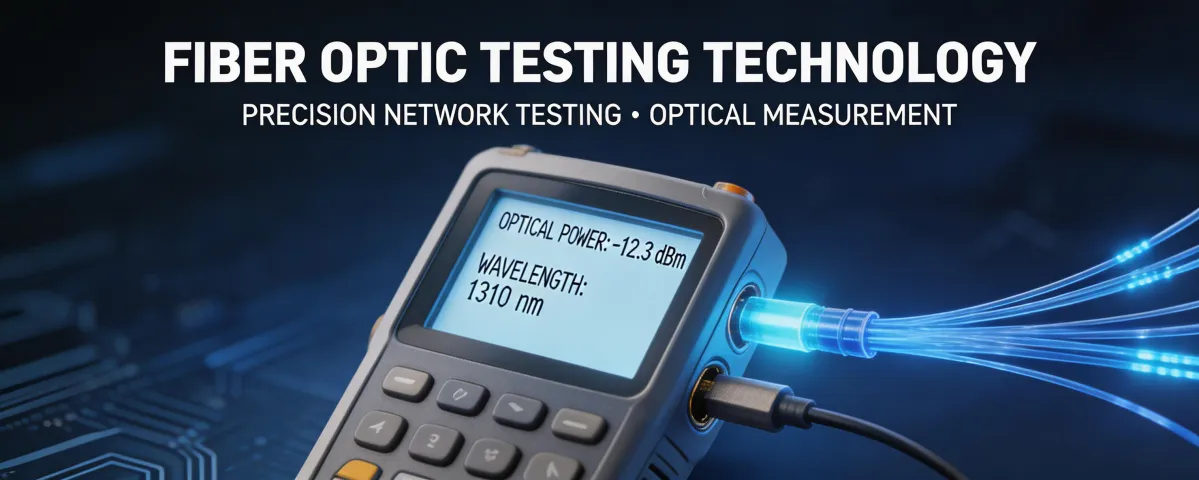
In March 2024, one of our senior fiber techs asked me to approve an EXFO 4 channel attenuator. My first reaction wasn't a question. It was 'No.' We already had two single-channel attenuators, and they worked fine. I didn't see the point of spending roughly $6,000 on something that looked like a lab instrument.
I'm the procurement manager at a 90-person fiber contracting company. I've managed our test and measurement budget—about $240,000 a year—for eight years. I've compared 30+ vendors, watched every invoice, and built a TCO spreadsheet that has caught more hidden fees than I'm comfortable admitting. So when I say I was wrong, I want you to understand how annoying it is for me to say that.
The Purchase Request I Almost Rejected
The first warning sign was the word 'simultaneous' in the justification. The tech explained that a 4 channel attenuator lets you attenuate four optical paths at once, so you can test a 12-fiber MPO trunk or a DWDM link without re-patching every path. My single-channel brain said, 'So what? You test one at a time and add a few minutes.' My cost-controller brain said, 'That is exactly what the single-channel attenuators are for.'
Both of those brains were wrong.
The Deep Cause: We Were Testing 2025 Links With 2020 Methods
The problem wasn't the attenuator. The problem was the way we tested multi-fiber links.
We've been installing a lot of MPO trunk and small-count DWDM systems lately. On those builds, you need consistent attenuation across multiple channels. The single-channel approach means you test one fiber at a time, patch in a temporary fan-out, or build a launch configuration with more connectors than the link itself. Every extra connection is a place where the test can lie to you. Per IEC 61300-3-35, endfaces need to be clean and within grade before mating, and we weren't checking that on the attenuator side. The result was a phantom event (and, in our case, a near-miss).
So we started seeing OTDR events that looked like bad splices. One event at 12.4 km kept showing up as a 0.6 dB loss. The crew wanted to re-splice. They were about to cut a joint that was actually fine.
A tech who'd gone through EXFO OTDR training stopped them. 'That's not a splice,' he said. 'That's the connection between the launch cable and the attenuator.' He was right. The splice was fine. The test setup was wrong.
In other words, the assumption that a bad trace means bad fiber was backwards. The trace was bad because our test path had uncontrolled variables. The fiber was fine.
The HeartGuide Part That Stuck With Me
I'd never heard of EXFO's HeartGuide until that tech mentioned it after the class. He said it was the section of the training that taught him how to read subtle reflection patterns. The funny thing is, I'd paid for that training six months earlier and thought it was just a certificate. It wasn't. The EXFO OTDR training was the reason we caught the issue before re-splicing a perfectly good joint.
If you're thinking about EXFO OTDR training, don't treat it as a one-time expense. Send people every year, and ask them to bring back one change to your test procedure. The HeartGuide module is a good starting point, but the real value is what your techs bring back.
The Cost of Being Cheap
In our 2024 audit, I flagged every truck roll and retest related to 'unexplained OTDR losses.' Here's what showed up:
- 14 truck rolls for phantom bad splices at $240 each: $3,360
- 11 hours of retest overtime at $72 per hour: $792
- Connectors, bulkheads, and temporary enclosures: $1,150
- One service credit to a customer after a missed deadline: $4,200
Total: $9,502. And that's not counting the amount of trust we lost with the field team.
The EXFO 4 channel attenuator quote was $6,200 as of January 2025. Even if it only avoided half of those 14 truck rolls, the payback was under seven months. I should have done that math in March.
Enclosures Were the Same Lesson
Around the same time, we were pricing enclosures for a new campus build. A distributor suggested a Cypress vs the usual brand comparison. The Cypress unit cost 12% more, so I almost dismissed it. But once I looked at sealing, gasket availability, and the cost of carrying two sets of spare parts, the cheaper option was actually more expensive.
The enclosure is part of the test path too. A bad seal means water gets in, the technician has to redo the termination, and the OTDR trace will show a loss that has nothing to do with the splice. If you compare enclosures on unit price alone, you're missing the same hidden-cost problem I walked into with the attenuator.
What I'd Tell Another Cost Controller
If you're the person who signs the PO, here's the part I wish someone had told me:
- Buy the EXFO 4 channel attenuator if you do any multi-fiber or MPO work. It removes a variable from the test path, and that's not a convenience—it's a cost avoidance.
- Invest in EXFO OTDR training every year. The HeartGuide material alone is worth a few truck rolls' worth of avoided mistakes.
- Compare enclosures on TCO, not sticker price. Cypress vs your usual brand is not a trivial decision when you include gaskets, sealing, and repeat visits.
- Track retest reasons. You can't fix what you don't classify.
What was best practice in 2020 doesn't automatically apply in 2025. The fundamentals haven't changed—you still need clean connections, accurate attenuation, and trained people. But the execution has transformed. My experience is based on about 60 deployments with a regional contractor. If you're building hyperscale data centers or running long-haul routes, your numbers will look different. The pattern won't.
Looking back, I should have approved that attenuator in March instead of July. At the time, I didn't have the retest data. Now I do.